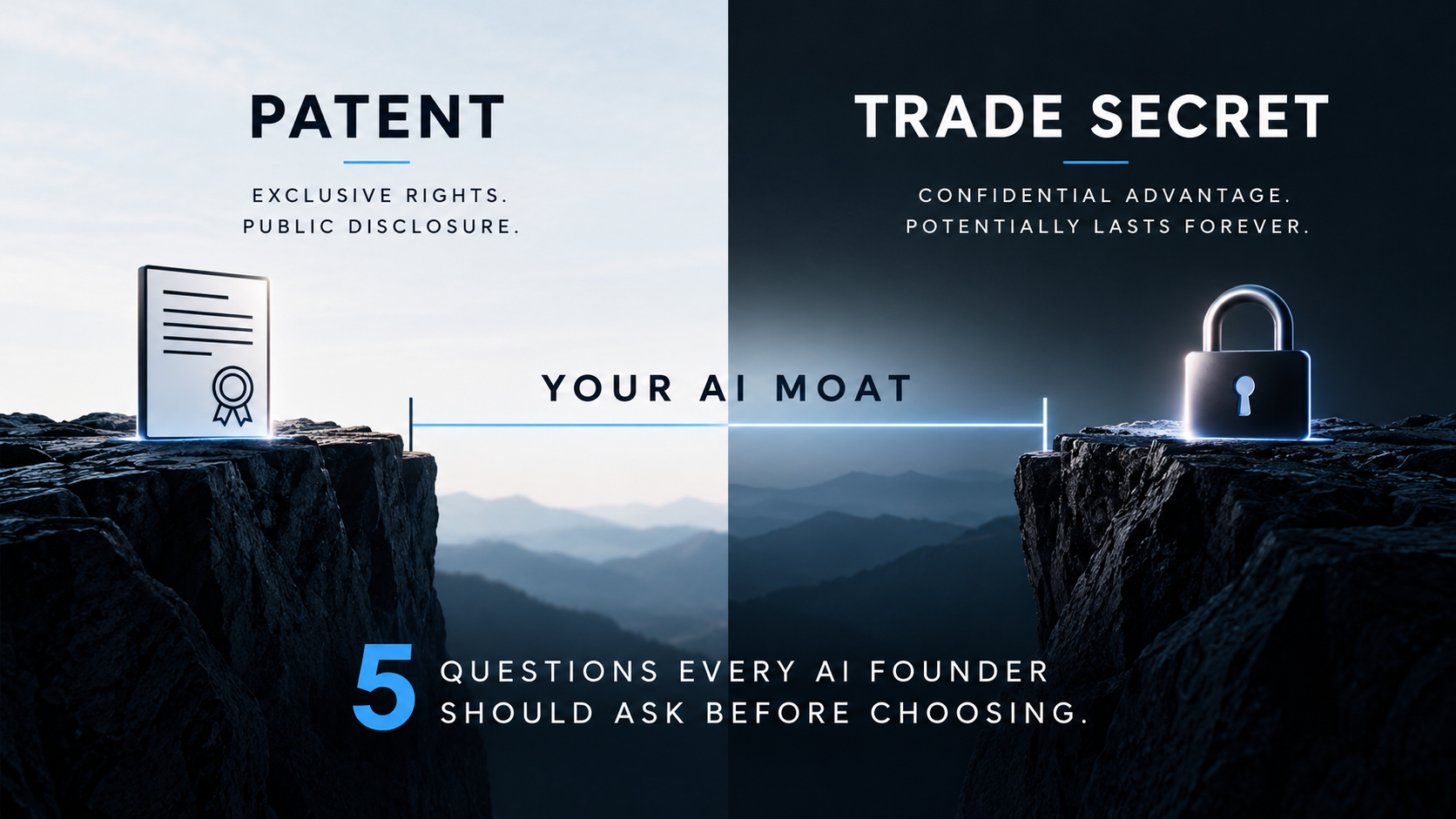
For an AI startup, intellectual property can become one of the most valuable assets on the balance sheet—even when it never appears there.
Your proprietary models, training methods, data pipelines, optimization techniques, algorithms, workflows, and infrastructure may be a significant part of what separates your company from competitors.
But protecting that advantage isn't as simple as filing a patent.
In some cases, patent protection can create a defensible moat around technology competitors might otherwise replicate. In others, filing a patent could require disclosing something that would have been more valuable kept secret.
That leaves founders with an important question:
Should you protect your AI innovation with a patent—or keep it as a trade secret?
There isn't one answer for every startup. The right strategy depends on what you've built, how easily someone else can discover it, and how you expect your competitive advantage to evolve.
Here's a practical framework for making the decision.
First: Understand What You're Actually Protecting
Before debating patents versus trade secrets, identify the specific innovation you want to protect.
"We use AI" isn't an IP strategy.
Your defensible asset might be:
- A proprietary model architecture
- A unique training or fine-tuning process
- A specialized inference technique
- A data-processing pipeline
- Proprietary datasets or data-selection methods
- A technical system that improves speed, cost, or accuracy
- A novel workflow integrating multiple technologies
- An algorithm that produces a commercially valuable result
The question isn't simply whether your company has valuable technology.
It's which pieces of that technology create an advantage competitors would care about reproducing.
Once you've identified those assets, you can evaluate how each should be protected.
Option 1: Patent Protection
A patent can give its owner the right to prevent others from making, using, selling, or importing a covered invention for a limited period of time.
For startups, that can be powerful.
A strong patent portfolio may create barriers for competitors, strengthen a company's position during fundraising or acquisition conversations, and provide leverage when entering strategic partnerships.
But patents involve a tradeoff:
You disclose the invention in exchange for legal protection.
That disclosure matters.
Once a patent application becomes public, competitors may gain insight into how the technology works—even if they cannot legally copy the patented invention.
Patents also require time and money to obtain and enforce. And not every AI-related innovation will qualify for patent protection simply because it is technically complex.
That means founders should be strategic about what they choose to patent.
Option 2: Trade Secret Protection
Trade secrets work differently.
Instead of publicly disclosing an invention, the company protects valuable information by keeping it confidential.
Trade-secret protection can potentially last indefinitely, provided the information remains secret and the company takes reasonable measures to protect it.
That can make trade secrets particularly attractive for AI companies.
Consider something like a proprietary training methodology running entirely inside your infrastructure.
If customers and competitors can't inspect the underlying process, reverse-engineer it, or determine exactly how it works from your product, revealing that methodology publicly through a patent filing may not always be the best move.
Keeping it secret could preserve the advantage much longer.
But trade secrets have their own weakness:
Once the secret is legitimately discovered, the protection may effectively disappear.
A competitor independently developing the same approach generally presents a very different situation from someone improperly obtaining confidential information.
Trade-secret strategies therefore depend heavily on confidentiality controls, contracts, internal processes, and information security.
The Decision Framework
When deciding between a trade secret vs patent for an AI startup, start with five questions.
1. Can competitors figure it out?
Ask what happens when someone gets access to your product.
Can they reverse-engineer the innovation?
Can they observe the output and reasonably determine what's happening underneath?
If your technology will eventually become apparent to competitors, trade-secret protection becomes less powerful.
Patent protection may deserve stronger consideration.
But if the innovation operates invisibly inside your infrastructure and would be extremely difficult to reverse-engineer, secrecy becomes much more valuable.
2. How long will this advantage matter?
AI moves quickly.
If today's breakthrough could become obsolete within two years, spending years pursuing patent protection may not create the return you expect.
On the other hand, if you've developed foundational technology you believe will remain important for a decade, formal patent protection may have significantly greater strategic value.
Ask:
Is this a temporary implementation advantage or a foundational technical advantage?
Those aren't the same thing.
3. Could someone independently invent it?
Trade-secret protection doesn't prevent competitors from independently developing the same technology.
Patents potentially can prevent others from practicing the patented invention even if they arrived at it independently, subject to the scope and validity of the patent.
So consider the likelihood that another capable engineering team could reach the same solution.
If several teams working on the same problem are likely to discover it, relying exclusively on secrecy could leave your advantage vulnerable.
4. What would disclosure reveal?
Imagine your patent application became public tomorrow.
What would a technically sophisticated competitor learn?
Would they discover a core part of your advantage?
Would the disclosure teach them something they otherwise might never have figured out?
Or would it mostly document technology they could already understand by examining your product?
The more valuable the hidden knowledge, the more carefully you should evaluate whether public disclosure makes strategic sense.
5. Can you realistically keep it secret?
Calling something confidential doesn't automatically make it a trade secret.
Think operationally.
Who has access?
Employees?
Contractors?
Development partners?
Customers?
Vendors?
Former employees?
As your startup grows, information naturally spreads across more people and systems.
A trade-secret strategy only works if the company actually treats the information like a secret through appropriate access controls, confidentiality agreements, documentation, security practices, and employee procedures.
If you can't realistically maintain confidentiality, your strategy needs to account for that.
The Answer May Be Both
Founders sometimes frame this decision as if the entire company must choose one strategy.
It doesn't.
An AI startup may patent one foundational technology while keeping its training methods, datasets, optimization processes, internal tooling, or implementation details confidential.
The stronger question isn't:
"Should we use patents or trade secrets?"
It's:
"Which parts of our competitive advantage should be patented, which should remain secret, and which aren't worth protecting at all?"
That creates an actual IP strategy.
Build the Strategy Before You Need It
IP decisions become harder when they're made reactively.
A fundraising round begins.
A competitor appears.
An enterprise customer asks about defensibility.
An acquisition conversation starts.
Suddenly, the company is trying to explain what it owns and how it's protected.
The better time to have that conversation is while you're building.
Map the technology that creates your advantage. Identify what competitors could reproduce. Determine what can realistically remain confidential. Then work with qualified IP counsel to evaluate what may be appropriate for patent protection.
Because for an AI startup, the moat isn't simply the technology you've built.
It's how difficult you make that technology to replicate.
At ForgeUp, we help founders think beyond building a great product to building a company that can defend its advantage as it scales. Through our IP & Defensibility pillar, founders work with experienced experts to identify where their real moat exists—and how to strengthen it before it becomes a problem.
Building an AI company with early traction? Learn more about ForgeUp and how we help founders turn traction into durable, scalable growth.
This article is for informational purposes only and does not constitute legal advice. Founders should consult qualified intellectual property counsel regarding their specific circumstances.
Keep on reading
Ready to ForgeUp?
Apply now and let's build the growth engine your company deserves.