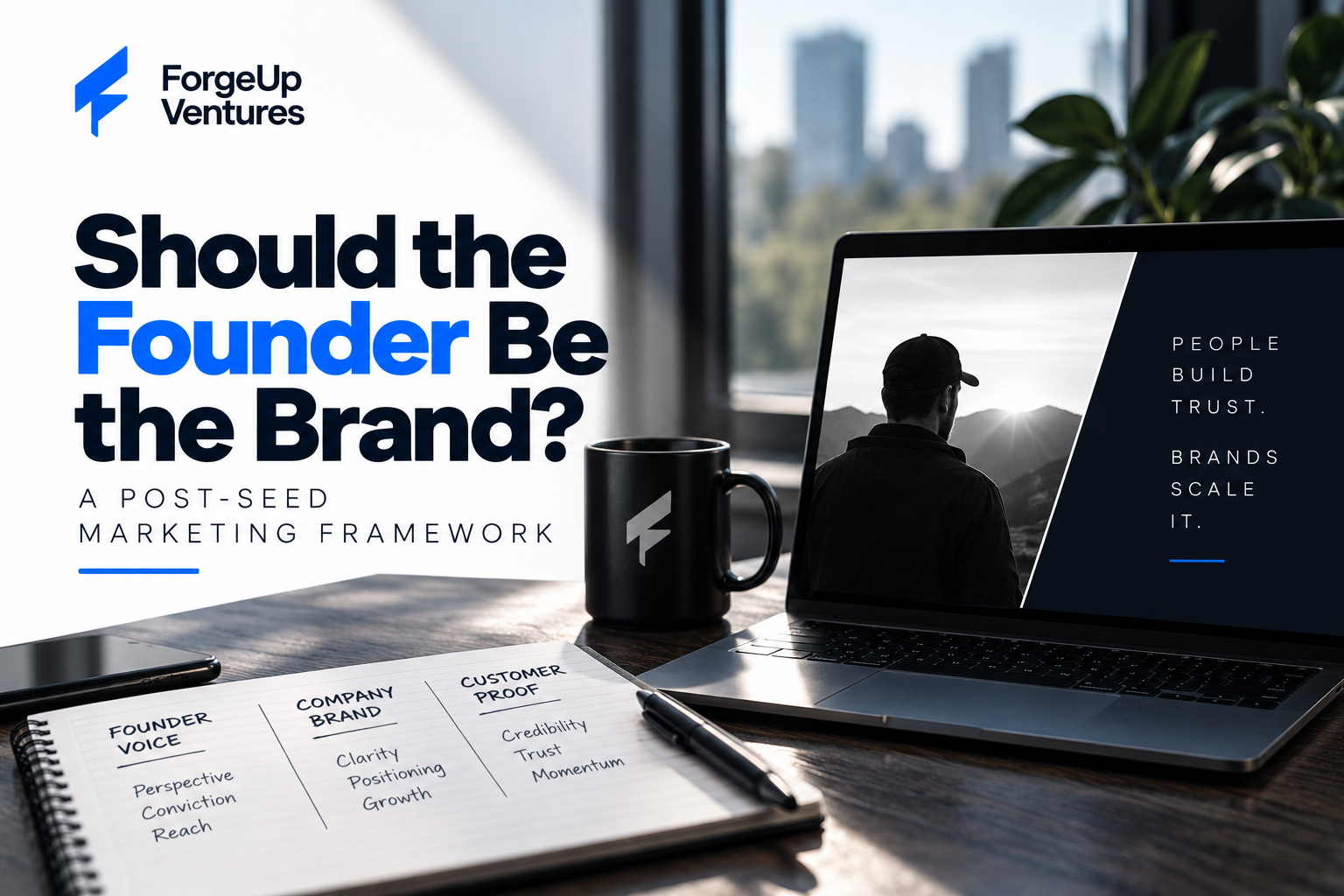
Should the Founder Be the Brand? A Post-Seed Marketing Framework
Open LinkedIn and you will see the strategy everywhere.
The founder posts constantly.
The founder tells the story.
The founder builds the audience.
The founder becomes the face of the company.
Often, it works.
People connect with people more easily than logos. A founder with a strong point of view can build trust, create conversations, attract talent, and generate awareness faster than a company page starting from zero.
There is a difference between using the founder to build the brand and making the founder the brand.
That distinction becomes increasingly important after seed.
As your company grows, your marketing strategy has to answer a bigger question:
If the founder stopped posting tomorrow, would the market still know why your company matters?
If the answer is no, you may not have built a company brand yet.
Founder-Led Marketing Works for a Reason
Founders have something corporate marketing often struggles to manufacture: proximity to the problem.
They know why the company exists.
They talk to customers.
They see what is changing in the market.
They have opinions about what their industry gets wrong.
That makes founder-led marketing powerful.
A strong founder voice can give a startup:
Credibility. Buyers hear directly from the person building the solution.
Reach. Personal accounts can create conversations that are difficult to generate through branded content alone.
Personality. Founders can communicate conviction, frustration, lessons, and experiences in a way a logo cannot.
Speed. A founder can respond to something happening in the market without waiting for a campaign.
At the early stage, those advantages matter.
So the answer is not to stop founder-led marketing.
The answer is to understand what it is supposed to accomplish.
The Founder Should Be a Distribution Channel, Not the Entire Brand
This is where startups can get into trouble.
Founder content starts working, so the company doubles down.
Every insight comes from the founder.
Every announcement features the founder.
Every meaningful conversation depends on the founder's audience.
Eventually, the company becomes difficult to separate from the individual.
That creates concentration risk.
What happens when the founder gets busy fundraising?
What happens when they stop posting consistently?
What happens when the company hires salespeople who need credibility of their own?
What happens when customers begin interacting with a larger organization?
The goal should be to use the founder's voice to accelerate trust while simultaneously building a company identity that can carry that trust forward.
Founder-led does not have to mean founder-dependent.
A Post-Seed Framework: Founder, Company, Customer
Instead of asking whether the founder or company should own the brand, think about your marketing across three voices.
1. The Founder Builds Conviction
The founder should talk about the market.
What is changing?
What does your industry misunderstand?
What have you learned from customers?
What do you believe that others in the space may disagree with?
This is where the founder's personal brand is most valuable.
Do not turn the founder's LinkedIn account into a company press-release feed.
Give people a reason to follow the person even if they never become a customer.
The founder's job is to create conviction and perspective.
2. The Company Builds Clarity
Your company channels have a different job.
They should make it easy for someone to understand:
What do you do?
Who is it for?
What problem do you solve?
Why are you different?
What proof do you have?
What happens next?
This is where positioning, messaging, product education, case studies, and consistent brand identity matter.
If someone discovers your startup through the founder and then visits your website, the company brand needs to continue the story.
If there is a disconnect, attention gets wasted.
The founder creates interest.
The company turns interest into understanding.
3. The Customer Builds Proof
There is a third voice startups often underuse.
The customer.
Eventually, the strongest claims about your company should not have to come from you.
Customer stories, outcomes, testimonials, use cases, referrals, and advocacy create evidence that neither founder content nor polished brand messaging can replace.
A founder can tell the market what they believe.
The company can explain what it does.
Customers show whether it actually works.
Strong post-seed marketing needs all three.
When Should the Founder Lean In?
Founder-led marketing is especially valuable when your company is still establishing a category position, selling a complex product, entering an industry built on relationships, or building credibility with a relatively small group of buyers.
It also works well when the founder genuinely has something to say.
That last part matters.
Not every founder needs to become a content creator.
A forced personal brand usually feels exactly like what it is: forced.
Founder-led marketing can happen through LinkedIn, podcasts, events, customer conversations, newsletters, webinars, communities, or industry commentary.
The channel matters less than the authenticity and consistency of the perspective.
When Should the Company Brand Take More Weight?
As the business grows, the company should increasingly be capable of creating demand and trust independently.
That becomes important when:
You are hiring a larger sales team.
Multiple executives represent the business.
Customers interact with many parts of the organization.
Your product portfolio expands.
You are entering new markets.
Your founder no longer has the capacity to personally drive every conversation.
This does not mean the founder disappears.
It means the brand becomes bigger than one person.
That is progress.
Do Not Confuse Attention With Brand Equity
A founder can have 100,000 followers while the company still has weak positioning.
Those are not the same asset.
Attention is valuable.
But ask what happens after you get it.
Do people remember the company?
Do they understand the problem you solve?
Can they explain why you are different?
Does the founder's audience contain actual buyers?
Does attention convert into pipeline, partnerships, recruiting, or customer trust?
If not, you may have built an audience without building enough brand equity.
That is why the founder-led marketing personal brand vs company brand debate is the wrong framing.
You need both.
They simply have different jobs.
Build a Brand That Can Outgrow You
After seed, the founder should absolutely help build the company's audience.
Use the founder's perspective.
Use their credibility.
Use their proximity to customers and the market.
Let people see the humans building the company.
While you do that, build something that can eventually stand without them.
A clear position.
A recognizable company voice.
Customer proof.
Other credible leaders.
A repeatable distribution system.
A brand people understand even when the founder is not in the room.
The founder can open the door.
The company brand needs to give people a reason to stay.
Keep on reading
Ready to ForgeUp?
Apply now and let's build the growth engine your company deserves.