A Feature Prioritization Framework for Startups That Can't Build It All
Your roadmap has 47 things on it.
Engineering can realistically build six.
Welcome to product prioritization after seed.
At this stage, ideas are rarely the problem. Customers have requests. Sales has requests. Your biggest prospect wants one integration. A competitor just launched something new. Engineering sees technical improvements that need attention. And the founder has a list of product ideas that could "change everything."
They cannot all be priorities.
That is exactly why they need to be prioritized.
For an early-stage company with limited engineering resources, deciding what not to build can be just as important as deciding what to build.
The best roadmap is not the one with the most features.
It is the one that puts your limited resources behind the work most likely to move the business forward.
Here is a practical feature prioritization framework startup teams can use when everything feels important.
Start With the Outcome, Not the Feature
Before discussing what to build, define what the company is trying to accomplish.
Are you trying to:
Increase activation?
Improve retention?
Close larger customers?
Reduce churn?
Shorten implementation?
Increase expansion revenue?
Remove friction from the sales process?
Your answer changes how you evaluate every feature on the list.
A feature might be valuable someday but irrelevant to the company's most important objective right now.
That distinction matters.
If the company needs to improve retention, for example, a feature designed primarily to attract new users may deserve less attention than an unglamorous improvement that solves a recurring problem for existing customers.
Roadmaps should follow business priorities, not compete with them.
The Four Questions Every Feature Should Survive
Instead of debating features based on who argues most convincingly, run each meaningful request through four questions.
1. What Problem Does It Solve?
This sounds obvious.
It often is not.
"We need a dashboard" is not a problem.
"Customers cannot see performance without manually exporting data every week" is.
Those are very different statements.
Before something earns development time, the team should be able to clearly articulate the problem behind the request.
Ask:
Who has this problem?
How frequently does it happen?
How painful is it?
What are they doing today instead?
If you cannot clearly describe the problem, you probably are not ready to build the solution.
2. How Much Evidence Do We Have?
One customer requesting something does not automatically make it a priority.
Neither does one lost deal.
Look for patterns.
Have multiple customers requested it?
Are users repeatedly encountering the same friction?
Is it appearing in churn conversations?
Does product usage data support the hypothesis?
Is sales consistently losing qualified opportunities because of the same gap?
There is an important difference between:
"A customer asked for this."
and:
"We have evidence that this problem repeatedly affects our target customer."
The second deserves much more attention.
This does not mean you need enormous datasets before making product decisions. Early-stage startups rarely have them.
It means separating evidence from anecdotes.
3. What Business Outcome Could It Change?
Now connect the feature to the business.
Could it:
Unlock a valuable customer segment?
Improve conversion?
Increase retention?
Create expansion opportunities?
Reduce support costs?
Shorten the sales cycle?
Increase product adoption?
Protect an important competitive advantage?
The stronger and more direct the connection between the feature and an important business outcome, the higher it should move on the list.
This is where product prioritization becomes more than product management.
Your roadmap is an allocation of company resources.
Every engineering hour spent on one feature is an hour unavailable for something else.
Treat it accordingly.
4. What Will It Cost Beyond Development?
A feature does not stop costing you money when engineering ships it.
Someone has to maintain it.
Support it.
Document it.
Sell it.
Train customers on it.
Fix it.
Improve it.
Potentially integrate it with the rest of the product for years.
This is especially important when a large prospect asks for something highly specific.
The contract may look attractive.
But if closing it requires building functionality that nobody else needs, you may be quietly turning a scalable product into custom software.
Ask not only:
"Can we build this?"
Ask:
"Do we want to own this?"
Those are different questions.
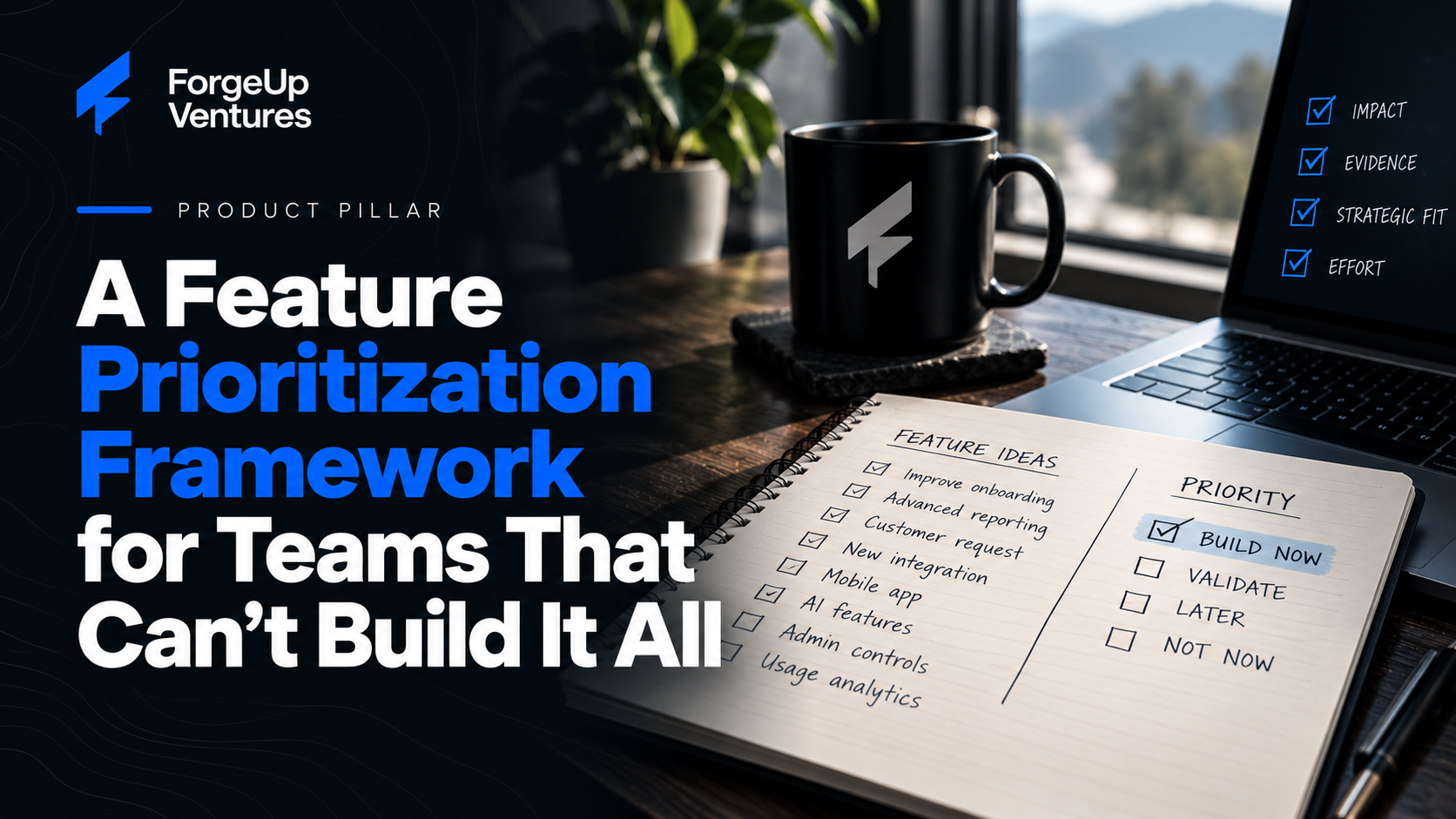
Score It: Impact, Evidence, Effort, Strategic Fit
Once a feature survives those questions, give the team a simple way to compare it against other priorities.
Score each proposed feature from 1 to 5 across four categories:
Impact: How meaningfully could this affect the outcome we are targeting?
Evidence: How confident are we that the problem is real and recurring?
Strategic Fit: How closely does this support our ICP, positioning, and product direction?
Effort: How expensive is this to build, launch, and maintain?
You do not need an elaborate formula.
The scoring system exists to create a better conversation.
A feature with high impact, strong evidence, strong strategic fit, and relatively low effort should naturally rise.
A feature with questionable impact, weak evidence, poor strategic fit, and enormous engineering effort should face a much higher bar.
The score does not make the decision for you.
It makes your assumptions visible.
That is the useful part.
Beware of the Loudest Voice in the Room
Without a framework, roadmaps tend to be shaped by whoever has the strongest immediate argument.
Sometimes that is the founder.
Sometimes it is sales trying to close a deal.
Sometimes it is your largest customer.
Sometimes it is a competitor.
All of those inputs matter.
None of them should automatically control the roadmap.
One of the hardest product disciplines after seed is learning to listen to customers without becoming completely reactive to them.
Customers are excellent at telling you about their problems.
They are not always the right people to design the solution.
Your job is to identify the pattern underneath the request.
Create a "Not Now" List
Prioritization does not require declaring every unselected idea bad.
Some ideas are good.
They are simply not important right now.
Maintain a visible "Not Now" list alongside your roadmap.
This accomplishes two things.
First, it prevents the team from repeatedly debating the same ideas.
Second, it creates permission to focus.
When priorities change, revisit the list.
Some items will move forward.
Others will become irrelevant.
Both outcomes are useful.
Your Roadmap Is a Strategy Document
A roadmap should not be a collection of customer requests.
It should show where the company believes product investment will create the most leverage.
That means saying no.
It means delaying good ideas.
It means occasionally disappointing a prospect.
And it means resisting the temptation to interpret every growth problem as a product problem.
Your team cannot build everything.
It should not try.
The question is not:
"Which features do people want?"
The better question is:
"Given what we are trying to accomplish, what is the most important problem our product team can solve next?"
Answer that consistently, and your roadmap becomes more than a development queue.
It becomes a growth strategy.
Keep on reading



Ready to ForgeUp?
Apply now and let's build the growth engine your company deserves.