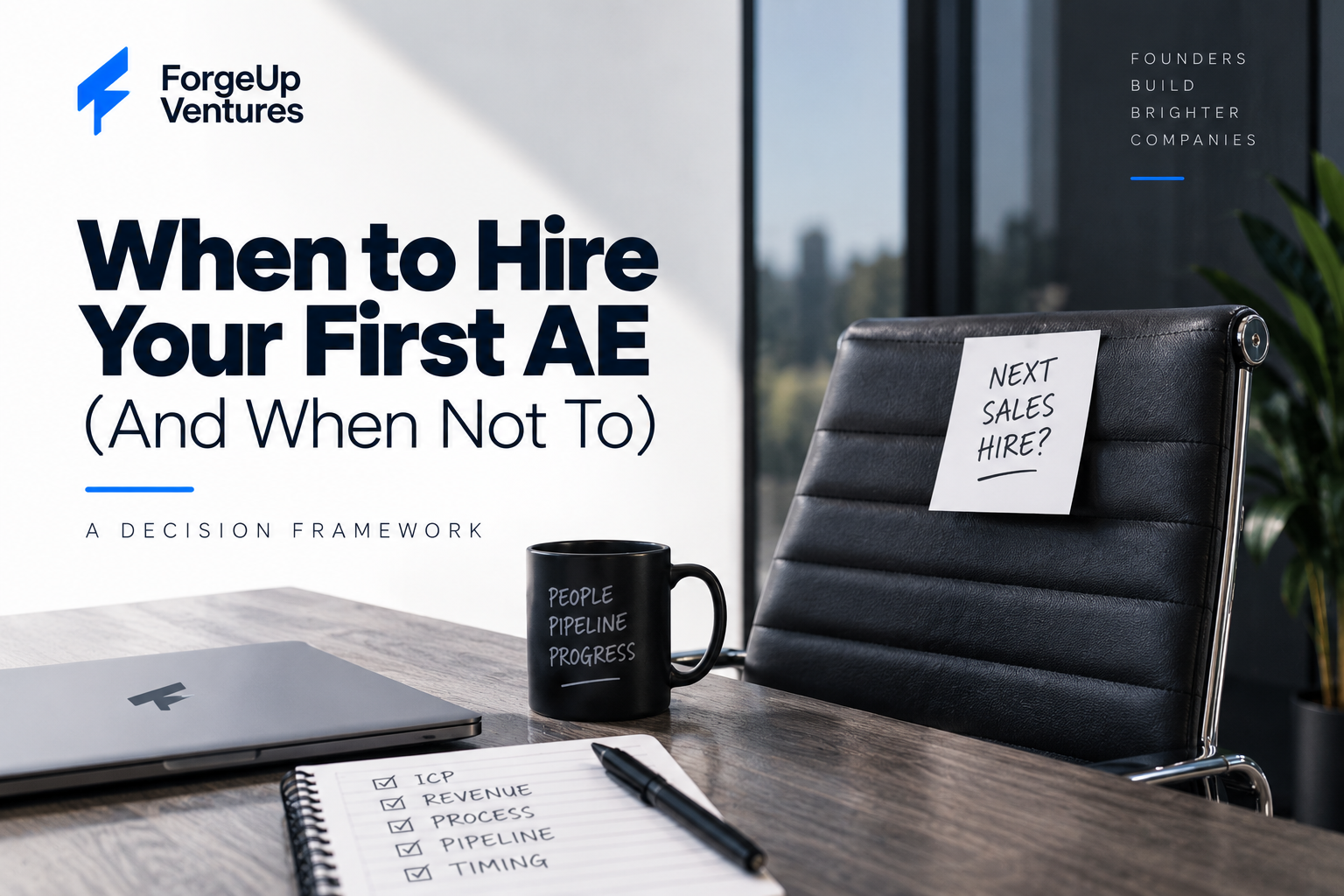
When to Hire Your First AE (And When Not To)
Hiring your first Account Executive feels like progress.
You are growing. The founder cannot handle every sales conversation anymore. There is capital in the bank. Pipeline needs attention.
So, naturally, you hire someone to sell.
Except there is one problem:
A salesperson cannot scale a sales motion that does not exist yet.
One of the most important decisions an early-stage founder will make is when to transition from founder-led sales to a dedicated sales hire. Do it at the right time, and your first AE can help turn what you have learned into a repeatable revenue engine.
Do it too early, and you may spend months blaming the salesperson for a problem they were never hired to solve.
So, when should you hire your first sales rep at a startup?
The answer has less to do with your funding round or headcount and more to do with what you have already proven.
Your First AE Should Not Be Your Sales Experiment
Early sales are supposed to be messy.
The founder is learning who buys, why they buy, what language resonates, which objections keep appearing, and what creates enough urgency for someone to sign a contract.
That learning is incredibly valuable.
It is also difficult to outsource.
If you hand an AE a broad market, an evolving product, unclear positioning, and a mandate to "go sell," you are not giving them a sales role.
You are giving them a discovery project.
Founders often expect the first salesperson to arrive with a playbook.
At this stage, your company should be building the playbook.
The AE's job is eventually to help execute and improve it.
Signal #1: You Can Describe Your ICP Clearly
Before hiring your first AE, you should be able to explain exactly who they should pursue.
Not:
"We sell to mid-market companies."
More like:
"We sell to operations leaders at 100 to 500-person logistics companies experiencing this specific problem."
The details will vary, but the principle is the same.
Your salesperson needs a target.
If every customer looks different, every deal has a different use case, and you are still trying to determine which market cares most, keep learning.
Your ideal customer profile does not need to be permanent.
It needs to be specific enough that someone else can prospect against it.
Signal #2: The Founder Has Closed Customers Repeatedly
One founder closing one customer is encouraging.
One founder closing multiple similar customers through a reasonably similar process is much more meaningful.
Before handing sales to someone else, you should have evidence that people will repeatedly pay for what you are selling.
That means understanding questions like:
Who initiated the conversation?
Why did the customer take the meeting?
What problem created urgency?
Who participated in the decision?
What objections came up?
Why did they ultimately buy?
You are looking for patterns.
Repeatability starts when individual wins stop feeling completely unique.
Signal #3: You Understand the Sales Process
Your sales process does not need to be sophisticated.
It does need to exist.
You should understand the basic journey from prospect to customer.
Perhaps that looks like:
Qualified lead → Discovery → Demo → Technical review → Proposal → Closed
Your stages may be different.
What matters is knowing what needs to happen for an opportunity to progress.
If the entire sales process currently exists inside the founder's head, your next step may not be hiring an AE.
It may be documenting what the founder is already doing.
Signal #4: There Is Enough Pipeline to Support the Hire
This is where startups sometimes get the sequence backward.
They hire an AE and then ask:
Where are the leads?
An Account Executive cannot close opportunities that do not exist.
Before hiring, understand how pipeline will be created.
Will the AE prospect?
Will the founder continue generating opportunities?
Do you have inbound demand?
Are partnerships creating leads?
Will an SDR support the motion?
There is nothing inherently wrong with hiring a full-cycle AE who prospects and closes.
But that expectation should be explicit.
Do not hire someone based on a healthy pipeline today if you have no repeatable way to replenish it tomorrow.
Signal #5: The Economics Can Support a Salesperson
A human-led sales process costs money.
Salary. Commission. Benefits. Tools. Management time. Ramp time.
Your pricing and deal economics need to support that cost.
If you are selling a low-cost product that requires months of calls to close, adding salespeople may make the economics worse rather than better.
Look at your average contract value, gross margin, sales cycle, customer acquisition cost, retention, and expansion potential.
You do not need perfect metrics yet.
But you should understand whether a sales-led motion has a realistic path to efficiency.
When You Should NOT Hire an AE
There are a few warning signs that the hire is probably premature.
You are hoping the salesperson will figure out who your customer is.
That is still founder work.
You cannot explain why recent customers bought.
Keep doing discovery.
Your positioning changes every few weeks.
The motion is still developing.
There is little or no pipeline.
Solve the pipeline problem before assuming a closer will solve it.
You are hiring because the founder hates selling.
This may be the most dangerous reason.
Founder-led sales is not just about generating revenue. It is one of the fastest ways to understand your market.
Getting away from those conversations too early can separate the founder from information the company desperately needs.
What Your First AE Actually Needs From You
Imagine your first AE starts Monday.
Could you give them:
A clearly defined ICP?
A list of target accounts?
Messaging that has already generated conversations?
A documented sales process?
Real customer stories?
Common objections and responses?
Pricing they can explain confidently?
A pipeline-generation strategy?
Clear expectations for their first 30, 60, and 90 days?
If most of those answers are no, the company probably needs more founder-led sales before adding another salesperson.
Hire to Scale Evidence, Not Hope
Your first AE is an important hire because it tests whether your sales motion can move beyond the founder.
That transition will never be perfectly clean.
The founder will still be involved.
Messaging will continue changing.
The product will evolve.
The AE will discover things you missed.
That is normal.
The goal is not to hand them a finished machine.
It is to give them enough evidence that a machine can be built.
Before you hire, prove that a specific customer has a meaningful problem, your product solves it, customers will pay for that solution, and there is a process for finding more of them.
Then bring in someone who can help you do it again.
And again.
And again.
Because your first sales hire should not be responsible for proving that your company can sell.
They should help prove that your company can sell without everything depending on the founder.
Keep on reading

Ready to ForgeUp?
Apply now and let's build the growth engine your company deserves.