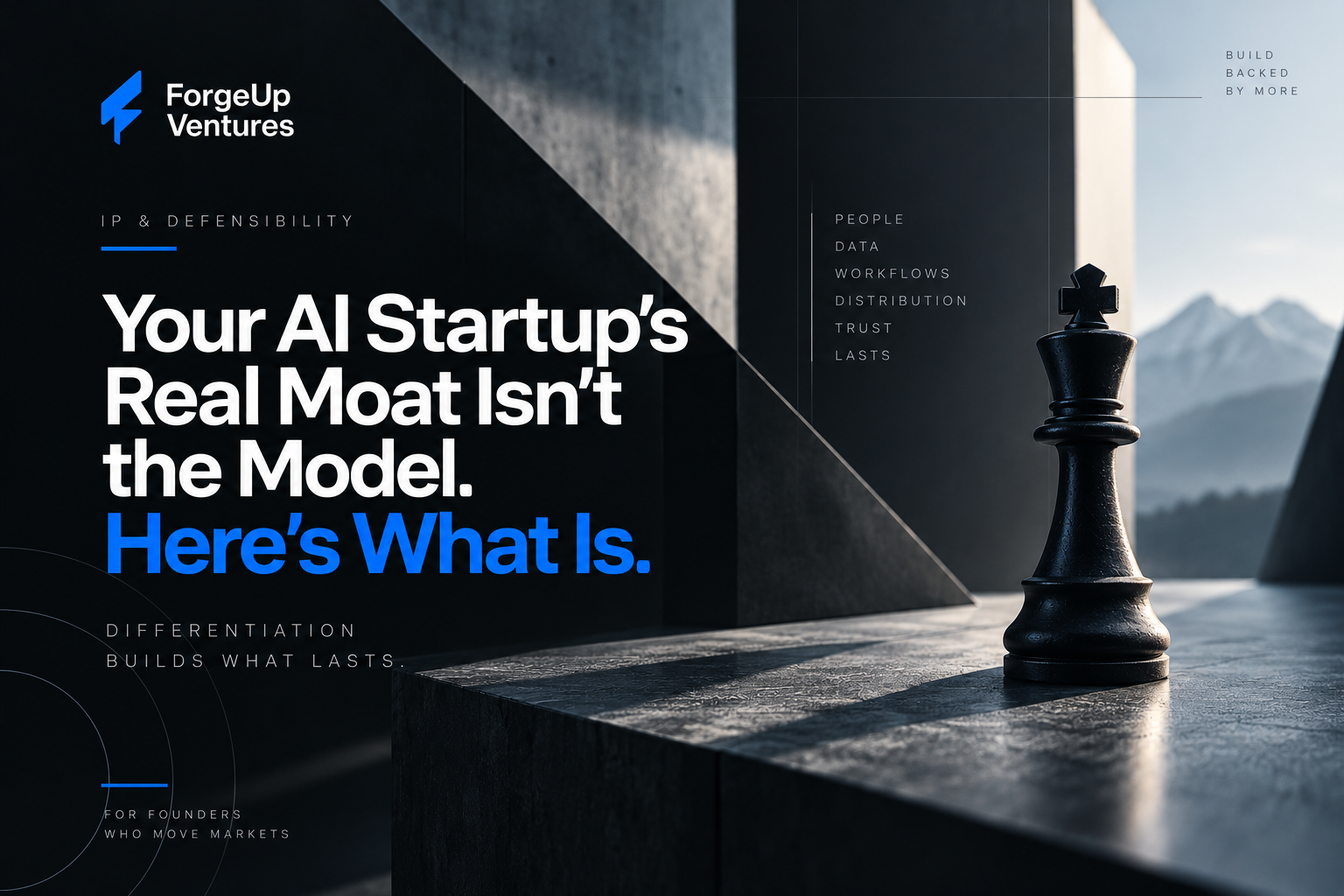
Your AI Startup's Real Moat Isn't the Model. Here's What Is.
Every AI startup wants a moat.
The problem is that many founders are looking for it in the wrong place.
A team builds a sophisticated product on top of a powerful model. The output is impressive. Customers respond. Investors pay attention.
Then six months later, a new model launches.
It is faster. Cheaper. More capable.
Suddenly, features that took months to build can be replicated in days.
That is the uncomfortable reality of building in AI right now.
Access to intelligence is becoming easier. Access alone is not defensibility.
If your competitive advantage disappears when a better foundation model becomes available, you probably did not have much of an advantage to begin with.
The strongest AI startup moat is increasingly built around the model, not inside it.
For founders building toward scale, that distinction matters.
A Better Model Is Not a Business Moat
There is nothing wrong with having superior technology.
Technical advantage matters.
The mistake is assuming that today's technical advantage will automatically remain tomorrow's competitive advantage.
AI infrastructure is evolving too quickly for most startups to rely on model performance alone.
Capabilities that once required specialized teams and significant capital are becoming available through APIs, open-source models, development tools, and increasingly capable platforms.
That means competitors can access many of the same underlying building blocks.
The question becomes:
What does your company own that gets stronger even when everyone has access to better AI?
That is where defensibility begins.
1. Proprietary Data Can Create Compounding Advantage
Data is often the first answer founders give when asked about their moat.
"We have proprietary data."
Maybe.
But simply possessing data does not make it defensible.
The better questions are:
Is the data unique?
Can competitors acquire something similar?
Does it improve the product?
Does the dataset become more valuable as customers use the platform?
Do you have the rights to use it in the way your business requires?
A strong data moat creates a compounding loop.
Customers use the product.
That usage generates proprietary information or feedback.
The information improves the experience.
The improved experience attracts or retains more customers.
More customers generate more useful information.
Now your advantage becomes harder to reproduce because a competitor cannot simply access the same model and arrive at the same result.
They would also need to recreate the accumulated intelligence generated through your product.
The moat is not data sitting in a database. It is the system that makes the data increasingly valuable.
2. Workflow Integration Is More Defensible Than a Feature
AI founders understandably spend a lot of time thinking about what their product can do.
Customers often care more about where it fits.
A clever AI feature may be easy to replicate.
A product deeply embedded in a customer's operations is much harder to replace.
Consider the difference.
One product generates an impressive output when a user enters a prompt.
Another product sits inside a critical workflow, connects to existing systems, understands organizational context, triggers actions, captures feedback, and becomes part of how the team operates every day.
The underlying AI capability might be similar.
The defensibility is not.
When your product becomes infrastructure rather than a novelty, switching becomes more difficult.
There are integrations to replace.
Processes to change.
Historical context to migrate.
Employees to retrain.
Internal habits to rebuild.
This does not mean creating artificial friction to trap customers.
It means creating enough real operational value that replacing your product carries a meaningful cost.
Own the workflow, not just the feature.
3. Distribution Is Still a Moat
AI did not eliminate one of the oldest truths in business:
The best product does not automatically win.
The product customers know about, trust, and can actually buy has an enormous advantage.
That makes distribution particularly important in AI, where product capabilities are converging quickly.
If two startups can deliver similar outcomes, but one has established partnerships, trusted customer relationships, an effective sales motion, or access to a difficult-to-reach market, the technology alone will not determine the winner.
Distribution can take many forms.
It could be a channel partnership.
A founder with deep credibility in a specific industry.
A community of highly engaged users.
An enterprise sales motion competitors struggle to reproduce.
A strategic integration that puts the product directly in front of buyers.
Or a reputation that makes your company the trusted choice in a high-risk environment.
Models can be copied.
Trust and distribution are much harder to copy.
4. Customer Feedback Loops Create Speed
Early-stage founders often think defensibility means building something competitors can never reproduce.
That bar is unrealistic for many startups.
Sometimes the advantage is not that competitors cannot copy you.
It is that they cannot learn as quickly as you do.
This is where customer proximity becomes powerful.
If your company is deeply connected to a narrow market, every implementation, support request, sales conversation, and product interaction teaches you something.
You learn which problems matter most.
You understand where AI fails in real-world environments.
You see edge cases competitors miss.
You discover which outputs customers trust and which require human intervention.
You learn what buyers will actually pay for.
That knowledge compounds.
A competitor looking at your product from the outside sees features.
You see the hundreds of customer conversations and decisions that explain why those features exist.
That learning advantage can become a meaningful moat, especially in specialized markets.
5. Domain Expertise Matters More Than "AI Expertise"
There are thousands of teams capable of building with AI.
Far fewer deeply understand the industries they are trying to transform.
That creates opportunity.
A healthcare workflow, industrial process, legal function, insurance operation, or financial system has nuances that are difficult to understand from the outside.
There are regulations.
Legacy systems.
Unusual buying processes.
Industry-specific language.
Risk considerations.
Exceptions that only become obvious after years of experience.
Founders who combine technical capability with genuine domain expertise can build products that generic competitors struggle to replicate effectively.
The AI may be available to everyone.
The context is not.
This becomes even more powerful when domain expertise shapes everything from product architecture and data strategy to positioning, sales, and implementation.
6. Intellectual Property Still Matters, but Be Specific
AI has made conversations around intellectual property more complicated, not less important.
Founders should understand exactly what they own and what they depend on.
That includes code, patents where appropriate, proprietary processes, datasets, trade secrets, trademarks, licensing rights, contractual rights, and the terms governing any third-party models or tools used inside the product.
A vague claim that "our technology is proprietary" is not enough.
Ask harder questions.
What part of the technology is actually ours?
What happens if our model provider changes its pricing or terms?
Could we move to another model if necessary?
Do we own the data required to operate the product?
Are there technical processes worth protecting?
Are our employee and contractor IP assignments in order?
Where could a competitor legally reproduce what we have built?
Strong defensibility starts with understanding exactly where your intellectual property begins and where someone else's ends.
7. Brand and Trust Become More Valuable as AI Becomes Commoditized
As AI-generated products multiply, buyers face a new problem.
They have more choices and less certainty.
Can they trust the output?
Can they trust the company with sensitive data?
Will the product still exist next year?
Does the team understand their industry?
Can the system perform reliably in a high-stakes environment?
These questions make brand more than a marketing asset.
Brand becomes a risk-reduction mechanism.
If customers trust your company to deliver consistently, protect their information, understand their environment, and stand behind the product, that trust becomes difficult for a new competitor to recreate overnight.
This matters even more in enterprise markets where the cost of choosing incorrectly can be significant.
Your Moat Should Get Stronger as the Models Get Better
Here is a useful test for AI founders:
If the best model in the world became available to every startup tomorrow, would your company become less valuable?
If the answer is yes, pay attention.
Your advantage may be too dependent on technology you do not control.
The strongest AI companies should benefit when models improve.
Better models make their proprietary data more useful.
They make deeply integrated workflows more capable.
They improve an already established customer experience.
They strengthen products that already have distribution, trust, and domain expertise.
The underlying technology gets better, but the company's accumulated advantage remains.
That is the kind of moat worth building.
Build Beyond the Model
The AI layer matters.
But it is only one layer.
The companies that endure will build defensibility across multiple dimensions:
Proprietary data that compounds.
Workflows customers rely on.
Distribution competitors cannot easily access.
Customer relationships that accelerate learning.
Deep domain expertise.
Intellectual property that is clearly understood and protected.
A brand buyers trust.
None of these are as exciting as announcing a breakthrough model.
They are harder, slower, and less likely to generate an immediate headline.
They are also how durable companies get built.
So if you are a founder asking where your AI startup moat comes from, do not just ask whether your technology is better today.
Ask a harder question:
What are we building that becomes more valuable every time our customers use it, every time our team learns, and every time the underlying technology improves?
That is the advantage competitors cannot simply download.
And that is where the real moat begins.
Keep on reading
Ready to ForgeUp?
Apply now and let's build the growth engine your company deserves.