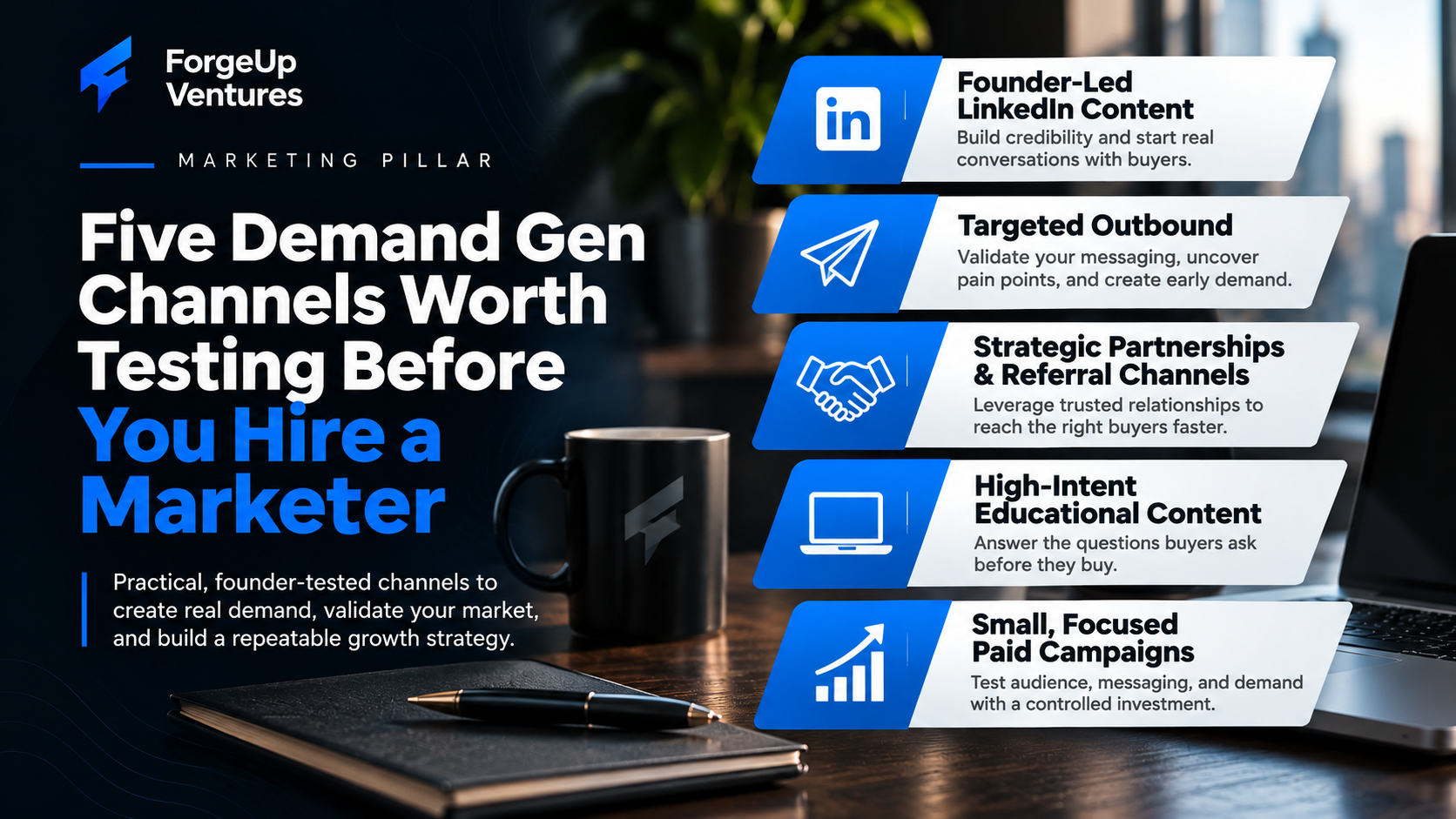
Five Demand Gen Channels Worth Testing Before You Hire a Marketer
For many post-seed founders, hiring a marketer feels like the logical next step after raising capital.
You have a product, early customers, and ambitious growth targets. Now you need more awareness, more leads, and a predictable way to generate demand.
Hiring someone to build demand before understanding where your buyers spend time can be an expensive experiment.
A marketer can scale a promising channel. They should not have to discover your entire go-to-market strategy from scratch.
Before making that hire, founders should test a handful of demand generation channels to understand which ones attract qualified buyers, create meaningful conversations, and contribute to revenue.
Here are five worth testing.
1. Founder-Led LinkedIn Content
For B2B startups, LinkedIn can be a practical starting point because founders often have direct access to potential buyers, partners, and industry decision-makers.
The objective is not to become an influencer.
It is to establish credibility with a clearly defined audience.
Start by identifying three problems your ideal customers regularly encounter.
Then publish content that demonstrates how you think about solving those problems.
Useful formats include:
- Lessons from customer conversations
- Common industry misconceptions
- Practical frameworks
- Observations about changing buyer behavior
- Specific problems your product addresses
Avoid turning every post into a product announcement.
Buyers are more likely to engage with useful expertise than a constant stream of promotional messaging.
Test two or three posts weekly for six weeks.
Track relevant profile visits, conversations with target buyers, inbound inquiries, and meetings influenced by your content.
Impressions can indicate reach, but qualified engagement provides stronger evidence of demand.
2. Targeted Outbound With a Clear Problem Hypothesis
Outbound prospecting is often categorized exclusively as sales.
For an early-stage startup, however, it can also serve as a valuable demand generation experiment.
Direct outreach allows founders to test messaging, identify buyer pain points, and discover which market segments respond.
Start with a narrow ideal customer profile.
Rather than targeting every company that could theoretically use your product, identify a specific buyer experiencing a specific problem.
Build a focused prospect list.
Then develop messaging around the business outcome your product helps achieve.
For example, instead of introducing your platform's features, explain the operational problem you believe the prospect is experiencing.
Measure positive reply rates, qualified conversations, and meetings booked.
Most importantly, document the objections and questions that repeatedly appear.
These insights can inform positioning, website messaging, and future campaigns.
Early outbound should produce market intelligence, not simply activity metrics.
3. Strategic Partnerships and Referral Channels
Some of the most effective demand generation opportunities come from organizations that already have relationships with your ideal customers.
Potential partners might include complementary software providers, industry consultants, service firms, or professional communities.
The key is identifying a shared audience without directly competing for the same business.
Begin with five potential partners.
Ask what challenges their customers face and whether your offering addresses a related need.
Then test a simple collaboration.
That might involve a joint webinar, educational resource, customer introduction, or referral arrangement.
Avoid building a complicated partnership program before validating mutual value.
Start small and measure results.
How many relevant introductions occurred?
Did those introductions become qualified opportunities?
Were the resulting customers a strong fit?
A successful partnership channel can eventually provide more predictable access to buyers without requiring substantial advertising spend.
4. High-Intent Educational Content
Content marketing does not require publishing several blog posts every week.
For early-stage startups, a smaller collection of highly relevant resources can be more valuable than a large library of generic articles.
Start with questions buyers ask immediately before making a purchasing decision.
These might involve:
- How to solve a specific operational problem
- How to compare competing approaches
- What implementation requires
- How to calculate the cost of an existing inefficiency
- Which mistakes to avoid when choosing a solution
Create content that answers those questions clearly.
A practical guide, comparison article, or implementation checklist may attract fewer visitors than a broad industry overview, but those visitors may have stronger purchasing intent.
Use customer language in headlines and structure content around the decisions buyers need to make.
Distribute each resource through founder LinkedIn posts, relevant communities, sales conversations, and partner networks.
The goal is not traffic for its own sake. It is attracting buyers already thinking about the problem you solve.
5. Small, Focused Paid Campaigns
Paid advertising can help founders test messaging and audience targeting, but it should not automatically become the first growth investment.
Before spending, make sure you understand your ideal customer, your core value proposition, and the action you want visitors to take.
Start with a narrow experiment.
For example, test search advertising against a small set of high-intent keywords or run a targeted campaign promoting a relevant resource.
Use a defined budget and testing period.
Evaluate the full journey from advertisement to qualified conversation.
A low cost per click does not necessarily indicate success.
Neither does a high number of form submissions.
What matters is whether the campaign attracts relevant buyers at an economically reasonable cost.
If conversion is weak, investigate the audience, message, landing page, and offer before increasing spending.
Paid campaigns should validate an acquisition hypothesis before they become a significant budget commitment.
How to Evaluate Your Demand Generation Experiments
Testing five channels does not mean operating all five indefinitely.
The objective is to identify where limited resources produce the strongest commercial signals.
For each experiment, establish four things before launching:
1. Audience: Who exactly are you trying to reach?
2. Hypothesis: Why should this channel work for that audience?
3. Success metric: What measurable behavior indicates meaningful interest?
4. Decision point: When will you continue, adjust, or stop the experiment?
Compare results using qualified conversations, opportunities created, customer acquisition costs where measurable, and the time required to operate each channel.
Remember that some channels produce results faster than others.
Outbound may generate immediate conversations, while organic content can require sustained effort before producing meaningful inbound demand.
Avoid declaring a channel ineffective simply because its results do not match another channel's timeline.
When Should You Hire Your First Marketer?
The right time to hire is not necessarily when you have funding available.
It is when you understand the problem the hire needs to solve.
If founder-led LinkedIn consistently generates qualified conversations, you may need someone to develop a repeatable content and distribution process.
If partnerships create opportunities, you may need support managing and expanding those relationships.
If paid campaigns demonstrate promising economics, you may need specialized performance marketing expertise.
The responsibilities should follow the evidence.
Hire to accelerate a validated opportunity, not to compensate for an undefined strategy.
For some startups, fractional marketing support may provide a more efficient bridge between founder-led experimentation and a full-time team.
Build Evidence Before Building Headcount
Demand generation for early-stage startups is not about appearing everywhere.
It is about learning where your buyers are, what motivates them, and which activities consistently create commercial opportunities.
The founders who approach marketing as a series of disciplined experiments gain something more valuable than a collection of leads.
They develop a clearer understanding of how their market responds.
That understanding makes future hiring, budgeting, and growth decisions significantly more effective.
At ForgeUp Ventures, we believe early-stage growth requires more than additional activity. It requires focused execution supported by measurable evidence.
Before you hire someone to scale your marketing, identify what is worth scaling.
That is how demand generation becomes a repeatable growth function rather than another expensive experiment.
Keep on reading



Ready to ForgeUp?
Apply now and let's build the growth engine your company deserves.