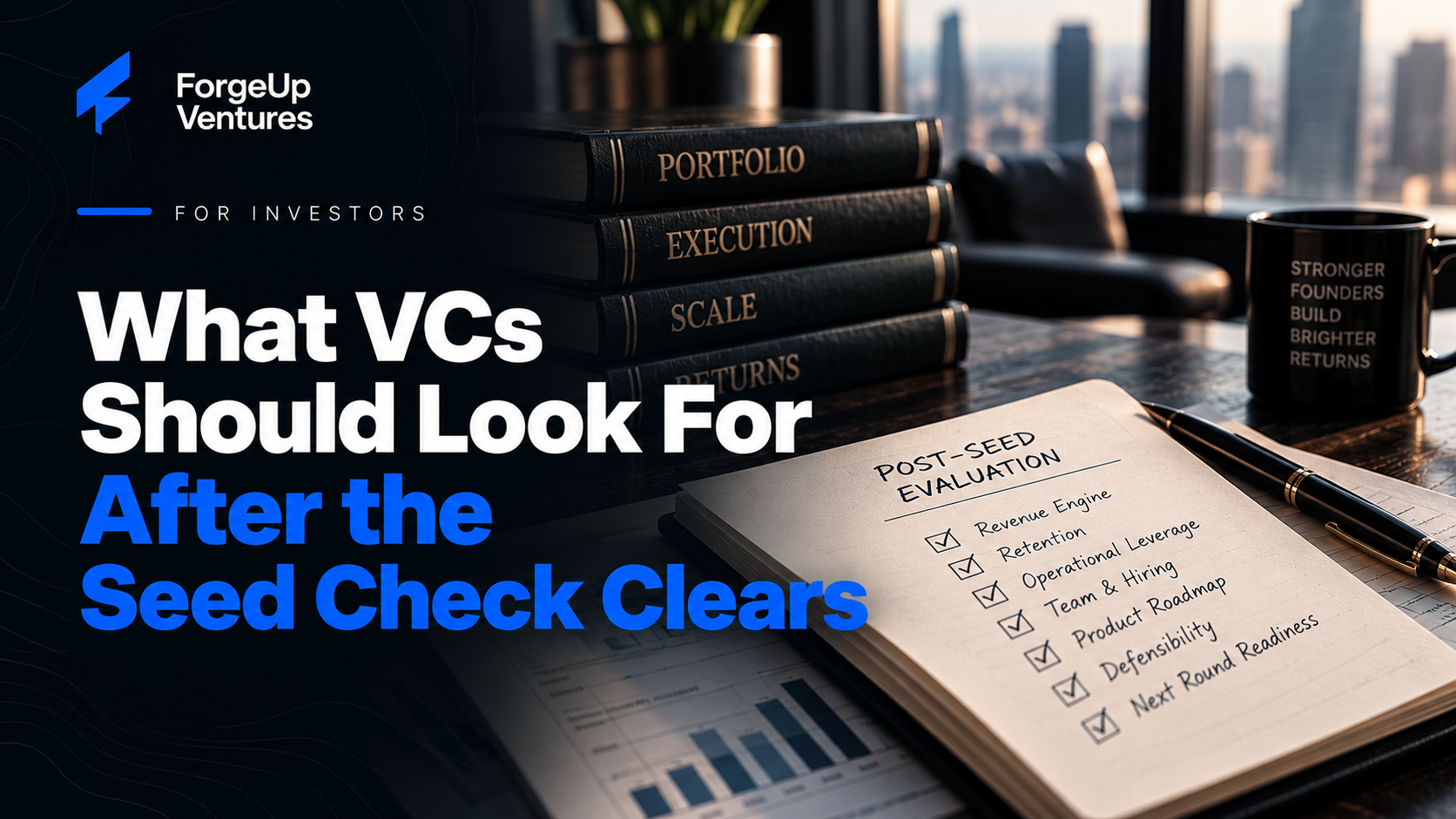
What VCs Should Look For After the Seed Check Clears
The seed round closes. The announcement goes live. The founder celebrates, investors congratulate the team, and everyone turns their attention to the next milestone.
For venture capital investors, the most revealing part of the company's journey is just beginning.
A successful fundraise demonstrates that a founder can communicate a compelling vision, establish credibility, and attract capital.
It does not necessarily demonstrate that the company can consistently acquire customers, retain revenue, build operational discipline, or scale its business model.
The real investment thesis begins getting tested after the seed check clears.
For VCs, angels, and venture scouts evaluating post-seed startups, the most meaningful signals are not always the ones appearing in investor updates.
They are the indicators showing whether capital is being converted into repeatable execution.
1. Is the Company Building a Repeatable Revenue Engine?
Early revenue can be misleading.
A founder might close several impressive deals through personal relationships, persistence, or highly customized sales efforts.
Those wins matter, but they do not automatically establish a scalable go-to-market motion.
Investors should examine how revenue is being generated.
Are customers coming from identifiable, repeatable channels?
Does the company understand its ideal customer profile?
Can the team explain why deals close, why others stall, and which activities consistently create qualified pipeline?
Is the sales process becoming more predictable?
The difference between early traction and scalable growth is repeatability.
A startup generating revenue through a structured process is building something fundamentally different from one relying entirely on founder-driven heroics.
The question is not simply whether revenue increased.
It is whether the company understands how to generate the next dollar.
2. Is Customer Retention Validating the Product?
Customer acquisition attracts attention.
Retention provides evidence that the product continues delivering value after the initial purchase.
For subscription businesses, investors should evaluate gross revenue retention, net revenue retention, customer churn, and expansion patterns.
Those metrics require context.
A company with strong net revenue retention may still be losing smaller customers while expansion from larger accounts masks underlying weaknesses.
Similarly, low churn among a small number of customers may not yet provide enough evidence of durable product-market fit.
Investors should look deeper.
Are customers consistently using the product?
Are they reaching meaningful outcomes?
Is adoption expanding within customer organizations?
Are renewals becoming easier because the product is embedded in essential workflows?
Retention is not simply a customer success metric. It is evidence of whether the company's value proposition holds up in practice.
Strong acquisition paired with weak retention may indicate that the business is growing its customer base without building a durable foundation.
3. Is the Founder Turning Capital Into Operational Leverage?
Seed funding creates capacity.
It does not automatically create operational maturity.
After raising capital, founders face a different challenge: translating resources into coordinated execution.
This is where investors should pay attention to how the company operates.
Are priorities clearly defined?
Does leadership understand which initiatives directly influence growth?
Are responsibilities assigned to accountable owners?
Can the team execute without every decision returning to the founder?
Are important projects moving forward consistently?
Many startups struggle because the founder remains the central point of coordination across sales, product, hiring, partnerships, and operations.
That approach may work during the earliest stages.
It becomes increasingly difficult as the organization grows.
Investors should look for evidence that the company is building systems, processes, and leadership capacity that reduce dependence on individual effort.
Operational leverage develops when the business can produce better outcomes without requiring proportionally more founder involvement.
4. Is the Company Hiring Against Real Constraints?
One of the most common assumptions following a seed round is that additional funding should immediately translate into additional headcount.
Hiring does not solve every execution problem.
In some cases, it introduces new complexity before the company understands what it actually needs.
Consider a startup hiring its first account executive.
If the founder has not validated the ideal customer profile, established a repeatable sales process, or identified reliable acquisition channels, that hire may inherit an undefined problem.
The same applies across marketing, product, and operations.
Investors should evaluate whether hiring decisions address demonstrated constraints or simply follow a conventional startup growth playbook.
Questions worth asking include:
- What specific bottleneck will this hire remove?
- What measurable outcome should improve?
- Is the function ready for a full-time employee?
- Could specialized or fractional support address the need more efficiently?
The strongest teams do not necessarily hire fastest. They allocate talent where it creates the greatest leverage.
5. Is the Product Roadmap Connected to Commercial Outcomes?
Product development is another area where activity can be mistaken for progress.
A startup may release features consistently while making limited progress toward revenue growth, customer retention, or competitive differentiation.
Investors should understand how product decisions are prioritized.
Are features connected to validated customer problems?
Does the roadmap address adoption barriers, expansion opportunities, or technical constraints?
Can leadership explain the expected business impact of major development initiatives?
Is the company willing to deprioritize requests that do not support its strategic objectives?
The goal is not to minimize innovation.
It is to ensure that limited engineering resources are being directed toward work that strengthens the business.
A productive roadmap is not measured by how much gets shipped. It is measured by what improves because those features were shipped.
6. Is the Company Building Defensibility Alongside Growth?
As AI capabilities become more accessible and competitive markets evolve, investors should also examine whether a startup is developing advantages that competitors cannot easily replicate.
Those advantages may include proprietary technology, protected intellectual property, differentiated data, customer integrations, distribution relationships, or deeply embedded workflows.
Not every startup needs a large patent portfolio.
Every venture-backed company should understand what makes its position increasingly difficult to challenge.
Investors should ask whether the company's competitive advantages are strengthening as it grows.
A business that becomes easier to replicate as technology advances may face significant challenges sustaining long-term value.
7. Is the Company Becoming More Investable?
The period following a seed round is ultimately about preparing the business for its next financing or strategic milestone.
That requires more than a larger revenue number.
Investors should evaluate whether the company is developing the evidence, financial discipline, leadership capacity, and operating consistency necessary to support its next stage.
Are financial forecasts grounded in operating assumptions?
Does the team understand burn rate and runway?
Are customer concentration risks visible?
Can leadership explain which milestones must be achieved before additional capital is required?
Are important legal, financial, and operational records organized for diligence?
A company may show encouraging growth while remaining operationally unprepared for its next round.
Series A readiness is built through the quality of execution between financing events, not through fundraising preparation alone.
The Opportunity for Investors: Look Beyond the Dashboard
Investor updates provide valuable information, but they rarely tell the entire story.
Revenue, pipeline, hiring, and product releases are important indicators.
What matters equally is the operating system producing those results.
For investors, the opportunity is to identify execution gaps before they become expensive problems.
That may mean helping a founder access experienced operators, strengthen go-to-market processes, improve financial visibility, or introduce specialized expertise without prematurely expanding fixed costs.
Capital opens the door to growth.
Capital alone does not build the infrastructure required to sustain it.
At ForgeUp Ventures, this is the challenge we focus on: helping post-seed founders move beyond strategy and into the hands-on execution required to build stronger businesses.
For VCs, angels, and venture scouts, supporting that transition is not simply an additional portfolio service.
It is an opportunity to strengthen the underlying companies in which they have invested.
The seed check is a starting point.
What founders build after it determines whether the original investment thesis becomes a scalable reality.
Keep on reading

Ready to ForgeUp?
Apply now and let's build the growth engine your company deserves.