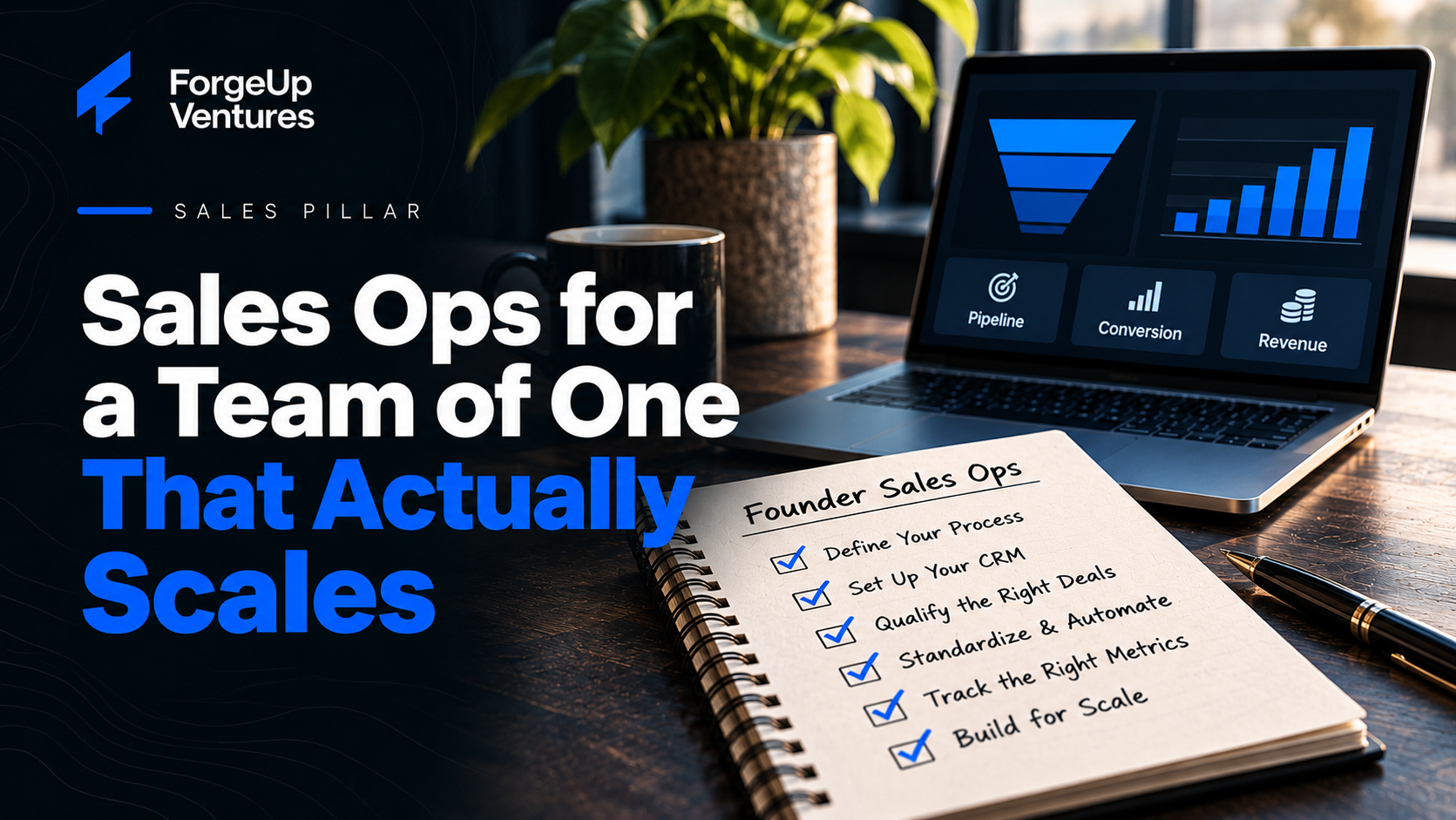
Sales Ops for a Team of One That Actually Scales
When you're the founder, you're often the entire sales department.
You're prospecting, running discovery calls, delivering demos, writing proposals, negotiating contracts, and following up with prospects. Somewhere between those responsibilities, you're also building the product, managing the business, and preparing for your next investor update.
At this stage, sales operations can feel like something you'll address when you hire your first account executive.
That's a mistake.
The systems you build while you're selling alone determine how easily your company can scale when you're no longer the only person selling.
The good news? Building effective sales ops for a solo founder startup doesn't require expensive software, complicated reporting, or a dedicated operations hire.
It requires a repeatable process that captures information, creates accountability, and makes revenue activity visible.
Here's how to build one.
1. Start With a Sales Process, Not a Technology Stack
Many founders begin by evaluating CRM platforms, automation tools, and sales intelligence software.
Software cannot fix an undefined sales process.
Before choosing tools, map the actual steps a prospect takes from initial contact to becoming a customer.
For an early-stage B2B startup, that might look like:
- Prospect identified
- Qualified
- Discovery completed
- Solution demonstrated
- Proposal submitted
- Negotiation
- Closed won or closed lost
Your stages should reflect meaningful changes in buyer commitment, not simply activities your team performs.
For example, sending an email doesn't necessarily mean an opportunity has advanced.
A prospect agreeing to a discovery meeting does.
Every pipeline stage should have a clear entry requirement and an expected next action.
This creates consistency and makes forecasting more useful as deal volume increases.
2. Build a CRM You Will Actually Maintain
A CRM is only valuable when the information inside it is accurate.
Founders frequently overcomplicate their setup by creating dozens of custom fields, reports, and workflows they rarely use.
Start with the essentials.
Every active opportunity should include:
- Company and primary contact
- Opportunity source
- Estimated deal value
- Current pipeline stage
- Expected close date
- Next action and follow-up date
- Relevant discovery notes
- Reason for loss, when applicable
Tools such as HubSpot, Salesforce, or another appropriately sized CRM can support this process.
The specific platform matters less than consistent usage.
After every meaningful sales interaction, update the opportunity.
Record what changed, what the buyer needs, and what happens next.
If an opportunity doesn't have a documented next step, it isn't being actively managed.
That single standard can eliminate substantial confusion as your pipeline grows.
3. Create a Qualification Framework
Not every interested prospect deserves the same amount of attention.
For a founder managing sales alongside every other business function, poor qualification creates an expensive distraction.
Develop a simple framework around four questions:
Fit: Does the prospect match your ideal customer profile?
Problem: Is there a meaningful business problem your product solves?
Urgency: Is there a compelling reason to address the problem now?
Buying process: Who makes the decision, and what needs to happen before purchasing?
You don't need a complex scoring model.
You need enough information to distinguish a legitimate opportunity from an interesting conversation.
Document the answers in your CRM so qualification becomes repeatable.
When you eventually hire a salesperson, they'll inherit a process based on evidence rather than intuition.
4. Standardize the Work You Repeat
Founder-led sales often involves repeating the same activities dozens of times.
Writing follow-up emails.
Preparing discovery questions.
Sending proposals.
Answering common objections.
Explaining implementation requirements.
Each repetition creates an opportunity to establish a reusable process.
Start by developing a small sales playbook containing:
- Ideal customer profile and buyer personas
- Discovery call questions
- Demo structure
- Follow-up email templates
- Common objections and responses
- Proposal templates
- Handoff requirements after closing
These materials don't need to be elaborate.
They need to reflect what's working.
Your first sales playbook should document a process you've validated, not one you hope will work.
Update it as customer conversations reveal new patterns.
5. Automate Administrative Work, Not Relationships
Automation can create significant leverage for a solo founder, but it should support the sales process rather than replace thoughtful communication.
Start with tasks that are repetitive and predictable.
Examples include automatically logging meetings, creating follow-up reminders, updating records through integrations, and generating standard documents.
You might also automate notifications when opportunities remain inactive beyond a defined period.
Avoid automating highly personalized outreach before understanding what messaging resonates with your market.
An automated sequence that consistently sends the wrong message only scales ineffective communication.
Automate the work around the relationship so you can spend more time developing the relationship itself.
6. Track Five Metrics That Actually Inform Decisions
A solo founder doesn't need an elaborate sales dashboard.
You need visibility into whether your sales motion is becoming more predictable.
Start with five metrics.
1. Qualified opportunities created: Are you consistently generating conversations with the right buyers?
2. Stage conversion rates: Where are opportunities advancing, and where are they stalling?
3. Sales cycle length: How long does it take qualified prospects to become customers?
4. Win rate: What percentage of qualified opportunities become closed-won deals?
5. Pipeline coverage: How much qualified pipeline exists relative to your upcoming revenue target?
Track these consistently, but interpret them carefully.
Early-stage pipelines often contain small sample sizes, making individual deals disproportionately influential.
The goal isn't to produce impressive charts.
It's to understand what is happening and make better decisions.
7. Establish a Weekly Sales Operating Rhythm
The most valuable sales operations system is one you consistently use.
Set aside 30 minutes each week to review your pipeline.
Ask yourself:
- Which opportunities advanced?
- Which deals have stalled?
- What follow-ups are overdue?
- What new qualified pipeline entered?
- What did I learn about customer objections?
- Which activities deserve attention next week?
Then update your CRM and assign next actions.
This operating rhythm turns sales from a collection of disconnected conversations into a manageable process.
It also helps founders recognize when a problem requires a change in messaging, qualification, pricing, or product positioning.
8. Build for the First Sales Hire Before Making It
One of the biggest advantages of establishing sales operations early is making future hiring more effective.
Your first salesperson shouldn't have to reconstruct your sales process from scattered notes, inbox conversations, and founder memory.
They should inherit documented qualification standards, a functioning CRM, a clear pipeline, and an established operating rhythm.
That doesn't mean every process must be perfect.
It means the business has developed enough repeatability for another person to execute it.
Before hiring, ask:
Can someone else follow our process and create opportunities without relying on my personal relationships or undocumented knowledge?
If the answer is no, your immediate priority may be improving the sales system rather than expanding headcount.
Sales Operations Is How Founder-Led Sales Becomes Scalable
At the earliest stages, founders are often the company's most effective salespeople.
They understand the product, the market, and the problem better than anyone.
Founder-led selling becomes a constraint when every opportunity depends on the founder's individual effort.
Sales operations creates the infrastructure to change that.
A defined pipeline.
A reliable CRM.
Consistent qualification.
Documented processes.
Useful metrics.
A disciplined weekly review.
None of these requires a large team or an enterprise technology budget.
Together, they create the foundation for repeatable revenue generation.
At ForgeUp Ventures, we see this transition as a critical part of moving from early traction toward sustainable growth.
You don't need to build a sales organization before you're ready.
You need to build a sales process that will be ready when your organization grows.
Keep on reading



Ready to ForgeUp?
Apply now and let's build the growth engine your company deserves.