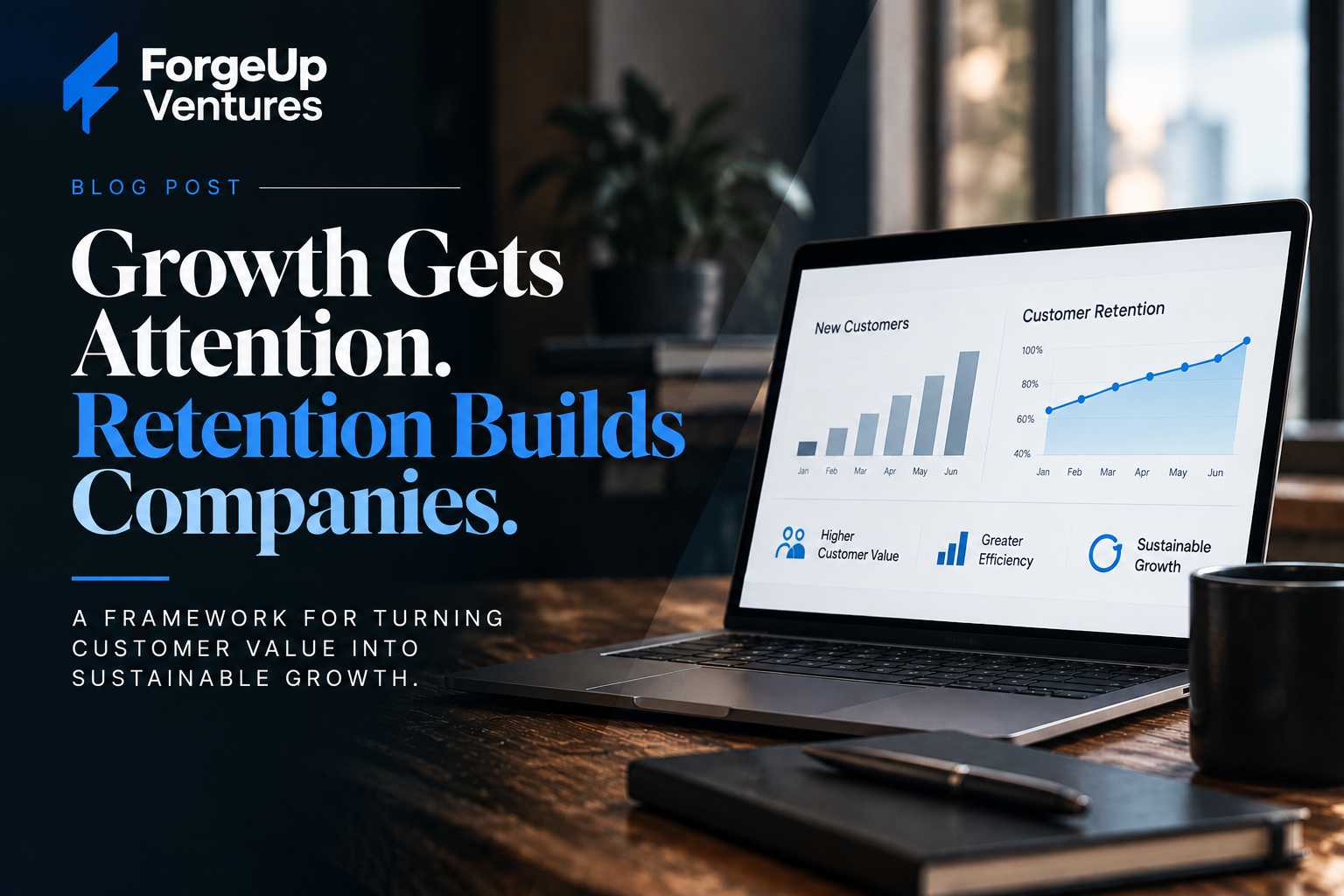
Retention Engineering: The Metric That Matters More Than Growth Right Now
Product Pillar | ForgeUp Ventures | October 20, 2026
Every startup wants growth.
More customers. More revenue. More traction. More momentum to show investors.
There's a question founders should be asking before investing in the next acquisition campaign:
Are we building a business customers want to keep using?
For early-stage startups, acquisition is often treated as the ultimate validation of product-market fit. A growing customer base looks promising, revenue charts move upward, and the business appears to be gaining traction.
Growth without retention can create a dangerous illusion.
If customers aren't consistently realizing value, every new acquisition simply replaces someone who left.
That's not scalable growth. That's an expensive cycle.
The startups that successfully move beyond initial traction understand something important:
Retention isn't just a customer success metric. It's a product engineering discipline.
Why Retention Deserves More Attention Than Acquisition
Acquisition tells you whether customers are interested enough to try your product.
Retention tells you whether the product delivers enough value for them to stay.
Both matter. But retention becomes especially important when a startup is trying to build predictable, repeatable growth.
Consider two hypothetical B2B SaaS companies.
Company A acquires 30 customers per quarter but loses 20% of its existing customer base during that period.
Company B acquires 15 customers per quarter but retains 95% of its existing customers.
Company A may initially appear to be growing faster. But Company B has a stronger foundation for compounding growth, assuming comparable starting customer bases and economics.
The distinction isn't simply how many customers each company acquires.
It's how much of that growth remains.
Acquisition creates opportunity. Retention determines how much of that opportunity becomes durable value.
For founders operating with limited capital and small teams, that distinction matters.
What Is Retention Engineering?
Retention engineering is the deliberate process of designing, measuring, and improving the product experiences that cause customers to return, continue using the product, and realize ongoing value.
It moves retention from a reactive customer success responsibility into a coordinated product, data, and operational priority.
Instead of asking, "Why did customers leave?" after churn occurs, retention engineering asks:
- What behaviors indicate a customer is receiving meaningful value?
- How quickly do new customers experience that value?
- Where do users disengage or encounter friction?
- Which product experiences encourage continued usage?
- What signals suggest an account is at risk?
The objective isn't simply to keep users active.
It's to make the product consistently valuable enough that continued usage becomes the natural outcome.
The Retention Engineering Framework
For early-stage founders, retention improvement doesn't require an enterprise analytics stack or a dedicated growth team.
It requires a focused operating system built around five priorities.
1. Define the Behavior That Represents Real Value
Logins, page views, and feature clicks can provide useful information, but they don't necessarily indicate that customers are achieving meaningful outcomes.
A founder must identify the actions most closely associated with sustained product value.
For a sales platform, that might mean completing a qualified workflow.
For an analytics product, it could mean generating a report that informs a business decision.
For a collaboration tool, it might involve multiple team members completing a shared process.
Start by identifying the behaviors that successful, retained customers consistently demonstrate.
Then determine whether those behaviors are genuinely predictive of retention rather than simply correlated with larger or more active accounts.
2. Measure Time to Value
The longer customers wait to experience a meaningful outcome, the more opportunities they have to disengage.
Time to value measures how long it takes a new customer to reach a defined value milestone.
Founders should examine onboarding friction, setup requirements, unnecessary steps, and unclear product guidance.
Ask:
What is the shortest realistic path between signing up and experiencing the product's core value?
Reducing that distance can improve activation and create stronger conditions for long-term retention.
3. Track Retention by Cohort
Aggregate retention rates can hide important problems.
A startup might report stable overall retention while newly acquired customers are disengaging faster than earlier customers.
Cohort analysis groups customers by a shared starting point, such as signup month or activation date, and measures their behavior over time.
This helps founders understand whether product changes, onboarding improvements, or new customer segments are producing better outcomes.
For B2B companies, distinguish between user retention, account retention, and revenue retention.
Each answers a different question.
A company can retain an account while individual users disengage—or retain users while losing revenue through downgrades.
4. Identify Friction Before It Becomes Churn
Customer churn rarely begins the day someone cancels.
Warning signs may appear much earlier:
- Declining usage of core workflows
- Incomplete onboarding
- Repeated support issues
- Reduced engagement from key stakeholders
- Failure to adopt essential features
These signals should trigger investigation, not automatic assumptions.
A decline in usage might indicate dissatisfaction, but it could also reflect seasonality or a completed workflow.
The goal is to identify patterns, understand their causes, and address the product or operational issues behind them.
5. Build a Continuous Retention Improvement Loop
Retention engineering only works when insights lead to execution.
A practical operating cycle looks like this:
Measure → Diagnose → Prioritize → Improve → Validate
Measure customer behavior and retention outcomes.
Diagnose where customers struggle or fail to realize value.
Prioritize the issues with the greatest likely impact.
Implement targeted product or process improvements.
Validate whether those changes actually improve customer outcomes.
Each cycle should produce a clear decision, an accountable owner, and a measurable result.
Without that discipline, retention analysis becomes another dashboard founders review without acting on.
The Retention Metrics Founders Should Actually Monitor
There isn't one universal retention metric for every startup.
The right measurements depend on the product, customer behavior, business model, and stage of growth.
For early-stage B2B SaaS companies, a useful starting point includes:
Customer Retention Rate: The percentage of customers retained over a defined period, excluding newly acquired customers.
Gross Revenue Retention (GRR): The percentage of starting recurring revenue retained after churn and contraction, excluding expansion.
Net Revenue Retention (NRR): The percentage of starting recurring revenue retained after accounting for churn, contraction, and expansion.
Activation Rate: The percentage of new customers reaching a meaningful first-value milestone.
Time to Value: The time required for customers to experience their first meaningful outcome.
The objective isn't to monitor everything.
It's to select the metrics that reveal whether customers are consistently receiving value and whether improvements are working.
For products with long implementation cycles or annual contracts, leading indicators may be especially important because revenue churn takes longer to become visible.
Retention Is a Cross-Functional Responsibility
Retention problems aren't always product problems.
Customers may leave because expectations were misaligned during sales, onboarding was ineffective, implementation took too long, or the product never addressed the buyer's actual priorities.
That's why retention engineering requires coordination across product, sales, marketing, customer success, and operations.
Each function contributes to the customer experience.
And each should be accountable for the commitments it makes.
For founders, this means replacing disconnected retention initiatives with shared priorities and clear ownership.
The Bottom Line: Build Growth That Stays
Acquisition matters. Revenue growth matters. New customers matter.
But none of those metrics tells the full story if customers aren't staying long enough to realize meaningful value.
For startups navigating the difficult transition from early traction to scalable growth, retention provides an essential signal of whether the business is building something durable.
The goal isn't to stop acquiring customers.
It's to ensure that acquisition is building on a product experience worth returning to.
Because sustainable growth isn't just about how many customers you win. It's about how much value you consistently deliver—and how many customers choose to stay.
At ForgeUp Ventures, we believe repeatable growth comes from disciplined execution across product, sales, marketing, and operations. Retention engineering is one part of building that foundation.
Keep on reading



Ready to ForgeUp?
Apply now and let's build the growth engine your company deserves.