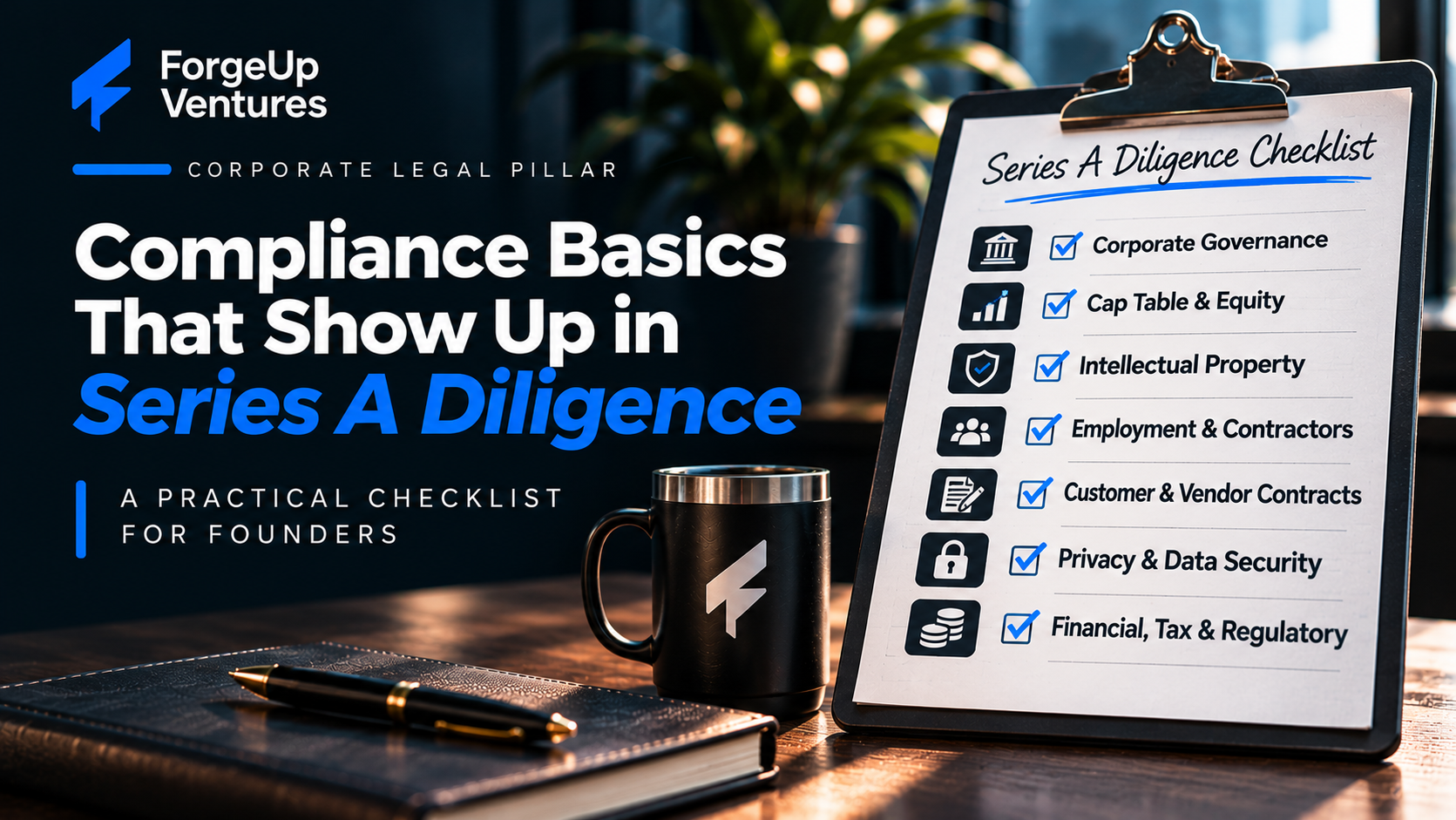
Compliance Basics That Show Up in Series A Diligence
Your startup has momentum.
Revenue is growing, customers are renewing, and investors are interested in your next round.
Then diligence begins.
Suddenly, questions surface about equity approvals, contractor agreements, intellectual property ownership, and corporate records that haven't been reviewed since the seed round.
None of these issues may seem urgent during everyday operations. But unresolved documentation gaps can delay financing, increase legal costs, and create uncertainty about the business investors are evaluating.
The most expensive startup compliance mistakes during Series A diligence are often the ones founders assumed could wait.
Preparing doesn't require building a large legal department. It requires knowing which records matter, keeping them organized, and addressing problems before they become financing obstacles.
Here's where to start.
1. Corporate Formation and Governance
Investors need confidence that the company was properly formed and that important corporate decisions were authorized.
Missing board approvals, inconsistent records, or outdated governance documents can create unnecessary complications.
Your checklist:
- Confirm formation documents and amendments are complete.
- Organize bylaws, board consents, and meeting minutes.
- Verify major financing and corporate actions received required approvals.
- Review entity registrations and required filings.
Corporate housekeeping is rarely exciting, but it establishes the foundation for everything else.
If decisions were made informally, work with counsel to determine whether corrective documentation is appropriate.
2. Cap Table and Equity Documentation
Your capitalization table should tell a clear, consistent story about company ownership.
Investors may compare the cap table against stock purchase agreements, option grants, financing documents, and board approvals.
Discrepancies can raise questions about ownership, dilution, and outstanding obligations.
Your checklist:
- Reconcile all issued shares, options, warrants, and convertible securities.
- Confirm equity grants were properly approved and documented.
- Review vesting schedules and exercise records.
- Organize SAFEs, convertible notes, and prior financing agreements.
- Check applicable securities filings and tax-related equity requirements.
For U.S. startups, certain equity decisions may involve Section 83(b) elections or Section 409A valuation considerations.
These requirements depend on the transaction and circumstances, making early legal and tax review important.
A clean cap table is more than an investor presentation tool. It's a record of legally significant transactions.
3. Intellectual Property Ownership
One of the most consequential diligence questions is whether the company actually owns the technology it depends on.
Founders sometimes assume that paying someone to develop software automatically establishes ownership.
That assumption can be dangerous.
Contractor arrangements, founder contributions, and early development agreements deserve particular attention.
Your checklist:
- Confirm founders, employees, and contractors signed appropriate IP assignment agreements.
- Review ownership of software, designs, inventions, and proprietary materials.
- Document relevant licenses and third-party technology dependencies.
- Evaluate open-source software obligations.
- Review patent applications, trademarks, and trade secret protections where applicable.
Investors want to understand whether the business controls the assets necessary to operate and grow.
Unclear ownership can create significant diligence concerns.
4. Employment and Contractor Compliance
Early-stage companies frequently rely on flexible hiring arrangements.
Informal employment practices can create legal and financial exposure as the organization expands.
Your checklist:
- Review employee offer letters and employment agreements.
- Confirm worker classifications are appropriate.
- Organize confidentiality and invention assignment agreements.
- Review payroll, wage-and-hour, and applicable employment requirements.
- Verify relevant policies and required employee records.
Contractor classification deserves particular attention because legal standards vary by jurisdiction and circumstances.
A person labeled an independent contractor is not necessarily classified that way under applicable law.
Addressing these issues early can reduce the risk of unexpected liabilities during diligence.
5. Customer and Vendor Contracts
Revenue growth looks promising, but investors also want to understand the contractual obligations supporting that revenue.
Customer agreements may contain terms affecting profitability, intellectual property, exclusivity, or future financing and acquisition transactions.
Your checklist:
- Organize executed customer and vendor agreements.
- Identify unusual termination or renewal provisions.
- Review exclusivity, indemnification, and liability obligations.
- Flag change-of-control or assignment restrictions.
- Confirm material commercial commitments are documented.
Pay particular attention to agreements with major customers.
A single contract can create meaningful commercial risk if it contains unfavorable or poorly understood terms.
6. Privacy, Security, and Data Handling
For AI and software startups, data practices can become a major diligence focus.
Investors may examine how the company collects, stores, processes, and protects customer information.
The applicable requirements depend on the company's operations, data, customers, and jurisdictions.
Your checklist:
- Review privacy notices and applicable data processing agreements.
- Document data access controls and retention practices.
- Confirm security policies reflect actual operations.
- Identify third-party processors and service providers.
- Review incident response procedures and material security events.
AI startups should also understand contractual restrictions governing training data, customer inputs, and model outputs.
A privacy policy is not a substitute for documented, functioning data governance.
7. Financial, Tax, and Regulatory Records
Legal diligence frequently overlaps with financial and operational review.
Investors may request evidence that the company has met applicable filing obligations and understands its regulatory exposure.
Your checklist:
- Organize federal, state, and applicable international tax filings.
- Review sales tax and other relevant tax obligations.
- Confirm business licenses and registrations where required.
- Maintain records of material disputes or regulatory inquiries.
- Reconcile financial records with significant contractual commitments.
Not every startup faces the same regulatory requirements.
A healthcare technology company, for example, may have different obligations from a general business software provider.
The objective is to identify the rules that actually apply to your company.
8. Build a Diligence-Ready Data Room
Having the correct documents is only part of the preparation.
Investors and their counsel also need to locate and review them efficiently.
Create a secure, organized data room with categories for corporate governance, capitalization, intellectual property, employment, commercial contracts, privacy, and financial records.
Assign responsibility for maintaining each category.
Use consistent naming conventions and restrict access to sensitive information.
Most importantly, review the contents regularly rather than waiting until fundraising begins.
Diligence readiness should be an operating discipline, not a last-minute project.
How to Prioritize Compliance Gaps
Not every missing document carries the same risk.
Start by identifying issues that could affect ownership, financing validity, intellectual property rights, material liabilities, or the company's ability to operate.
Work with qualified legal and tax advisers to distinguish administrative cleanup from matters requiring formal corrective action.
Create an action tracker with the issue, responsible owner, required documentation, and target resolution date.
This turns compliance preparation into a manageable execution process.
Series A Readiness Starts Before Series A
Strong revenue growth and a compelling market opportunity may attract investor interest.
They do not eliminate the need for sound corporate records, clear ownership, and disciplined legal operations.
For post-seed founders, addressing compliance gaps early protects valuable time and reduces avoidable uncertainty.
At ForgeUp Ventures, we believe operational readiness and legal discipline are essential components of building a scalable company.
The goal isn't to make your startup look perfect during diligence.
It's to demonstrate that the business has been built with the discipline necessary for its next stage of growth.
Keep on reading



Ready to ForgeUp?
Apply now and let's build the growth engine your company deserves.