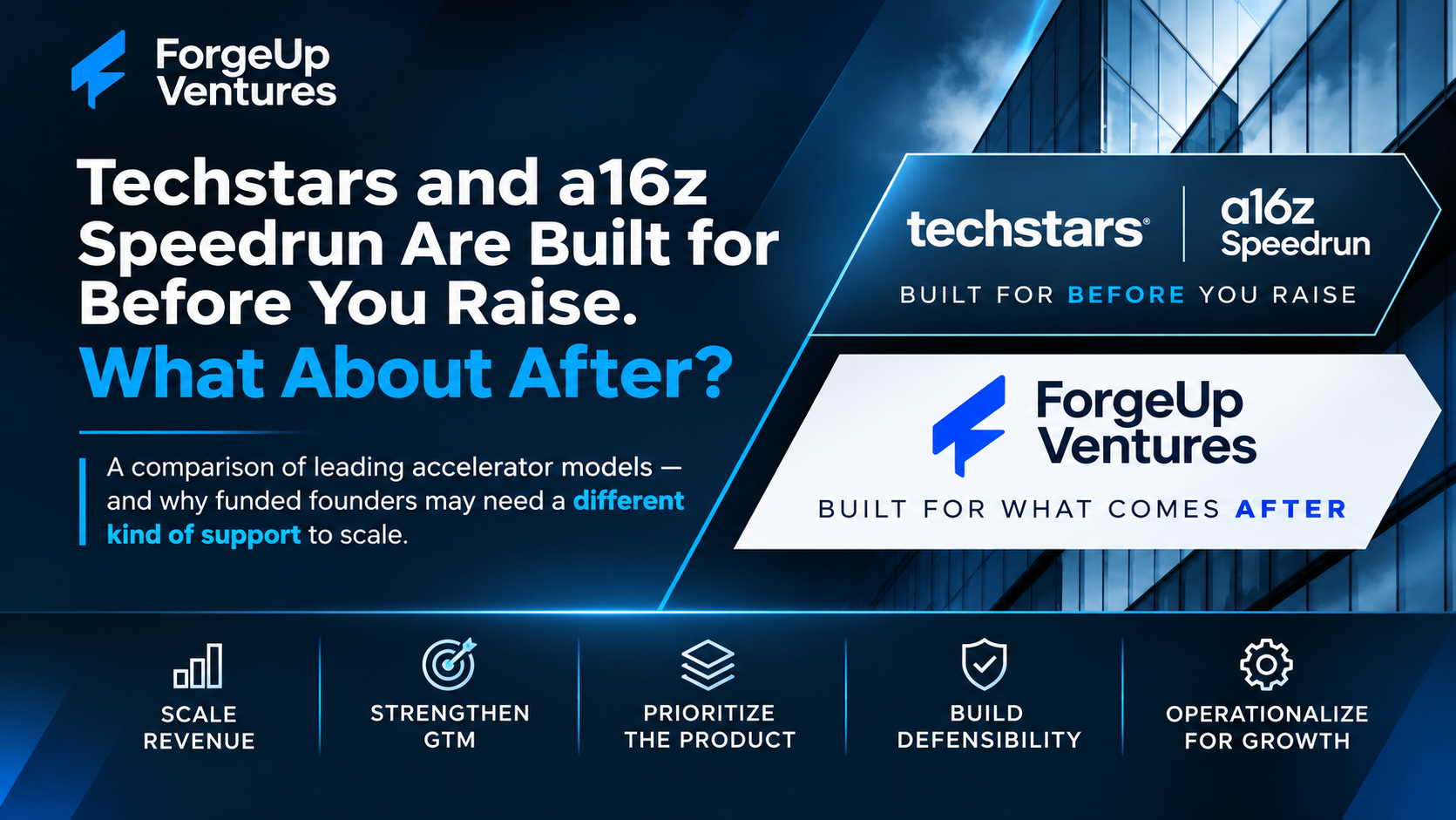
Techstars and a16z Speedrun Are Built for Before You Raise. What About After?
Why founders with funding and traction may need a different kind of growth program.
The startup ecosystem has become exceptionally good at helping founders get started.
Accelerators provide mentorship. Investors provide capital. Founder communities offer connections, resources, and access to people who have built successful companies before.
Programs like Techstars and a16z Speedrun have helped define what structured startup support can look like.
There is another stage of company building that deserves just as much attention.
What happens when you've already raised capital, found early traction, and now need to turn that momentum into a scalable business?
The challenges change. The decisions become more consequential. And the support that helped you get funded may not be the same support you need to grow.
For founders evaluating a Techstars alternative after securing funding, the most important question isn't which program has the biggest network.
It's which program is designed to solve the problems your company faces right now.
What Techstars and a16z Speedrun Do Well
Before discussing alternatives, it's worth understanding why established accelerator models remain valuable.
Techstars combines early-stage investment with a three-month, mentorship-driven accelerator experience. Founders receive structured programming, access to experienced mentors, investor connections, and a global network that extends beyond the program itself.
a16z Speedrun combines investment with access to operators, customer networks, talent resources, and specialized support. Its model is particularly relevant to technology companies seeking to accelerate development, distribution, and fundraising.
These programs are not exclusively for companies that have never raised capital. Nor does their support disappear after a funding round.
Their value is substantial.
However, their intensive program structures are designed to serve companies across important early stages of development, often combining capital formation, company building, network access, and growth preparation.
For a founder who has already secured funding and demonstrated market demand, the question becomes more specific:
Do you need another broad startup acceleration experience, or focused help executing your next stage of growth?
That distinction matters.
The Problem That Begins After the Seed Round
Raising capital creates opportunity.
It also creates expectations.
Before the round, a founder may be focused on demonstrating product-market fit, validating demand, securing early customers, and communicating a compelling investment thesis.
After the round, those priorities evolve.
Investors want evidence that the company can acquire customers consistently, retain them, manage capital responsibly, and build a repeatable business model.
Suddenly, founders face a different collection of challenges:
- The founder-led sales process needs to become a repeatable revenue engine.
- Marketing must produce qualified demand rather than occasional attention.
- Product decisions must balance customer requests against long-term strategy.
- Intellectual property and competitive positioning become increasingly important.
- Corporate governance and operational processes must support a growing organization.
These aren't necessarily problems solved by another pitch workshop or a larger contact list.
They're execution problems.
And execution problems require more than access to advice.
The Broken Middle: Where Promising Startups Lose Momentum
At ForgeUp Ventures, we call this stage the Broken Middle.
It's the space between proving that a company can work and demonstrating that it can grow predictably.
A startup may have raised a seed round, secured customers, and built a promising product without yet establishing the systems necessary for sustainable scale.
Revenue exists, but sales remain founder-dependent.
Customers are interested, but retention and expansion strategies are underdeveloped.
The product works, but the roadmap is increasingly reactive.
The company has resources, yet founders are still making too many operational decisions themselves.
This is where momentum can become misleading.
A growing company isn't automatically a scalable company.
The next stage requires turning early wins into repeatable systems, disciplined decisions, and measurable business outcomes.
For many funded founders, that's the real work ahead.
Techstars vs. a16z Speedrun vs. ForgeUp: What's Different?
These programs serve overlapping parts of the startup ecosystem, but their structures and positioning are different.
Techstarsa16z SpeedrunForgeUp VenturesCore modelInvestment and mentorship-driven acceleratorInvestment and operator-supported startup programPost-traction growth and execution programPrimary emphasisEarly-stage acceleration, mentorship, networks, fundraisingCapital, customers, talent, and company buildingAddressing growth bottlenecks across critical business functionsSupport approachStructured accelerator programming and ongoing networkIntensive residency, specialist support, and ongoing networkExpert-led, company-specific execution prioritiesFounder fitEarly-stage companies seeking investment and accelerationAmbitious technology startups seeking capital and growth resourcesFunded or revenue-generating AI and advanced-tech startups with traction
The takeaway isn't that one model is universally better.
It's that the right support depends on your company's stage, constraints, and immediate priorities.
A founder preparing to raise an initial round may benefit enormously from a capital-backed accelerator.
A founder with existing capital and customers may need a more targeted approach to converting that foundation into sustainable growth.
What a Post-Seed Growth Program Should Actually Deliver
For funded founders, the value of a growth program should be measured by what changes inside the business.
That starts with identifying the constraints preventing progress.
1. Sales: From Founder-Led Deals to Repeatable Revenue
Early sales often depend on a founder's relationships, credibility, and persistence.
Scaling requires something more systematic.
Founders need clearer ideal customer profiles, defined pipeline stages, effective qualification, enterprise sales strategies, and processes that can eventually support a broader team.
The goal isn't simply generating more meetings.
It's building a sales motion that produces increasingly predictable results.
2. Marketing: From Visibility to Demand Generation
Early marketing can become a collection of disconnected activities.
Social posts, campaigns, partnerships, and content may generate attention without creating meaningful pipeline.
A stronger growth approach connects positioning, audience understanding, demand generation, and conversion.
The objective is to identify which activities actually contribute to customer acquisition, then build on what works.
3. Product: From Feature Requests to Strategic Prioritization
Once customers arrive, product decisions become more complicated.
Every enterprise prospect has requirements. Every major customer has requests. Every competitor introduces new pressure.
Without disciplined prioritization, a startup can lose its strategic direction while trying to satisfy everyone.
Effective product guidance helps founders evaluate opportunities against retention, revenue, customer needs, and long-term differentiation.
4. IP and Defensibility: From Innovation to Competitive Advantage
For AI and advanced-technology companies, having impressive technology is not the same as building a defensible business.
Founders need to understand which advantages can be protected, which are operationally difficult to replicate, and how their intellectual property strategy supports commercial growth.
Defensibility should develop alongside the business, not become an afterthought when competitors emerge.
5. Corporate Legal: From Basic Formation to Growth Readiness
As startups grow, legal complexity grows with them.
Cap table accuracy, commercial agreements, intellectual property ownership, corporate governance, and investor documentation all become more important.
Addressing these areas proactively can help founders avoid unnecessary friction during partnerships, fundraising, and future transactions.
Together, these disciplines create a more complete foundation for scaling.
Why ForgeUp Was Built for This Stage
ForgeUp Ventures approaches startup growth from a different starting point.
Rather than centering the experience on securing a first investment, ForgeUp is designed for AI and advanced-technology founders who already have traction and some funding or revenue.
The focus is on what comes next.
Its model brings together expertise across sales, marketing, product, IP and defensibility, and corporate legal, supported by a fractional Chief of Staff function.
Instead of treating these areas as isolated conversations, the objective is to connect them around the company's actual growth constraints.
A pipeline problem may also be a positioning problem.
A retention problem may reveal weaknesses in onboarding or product prioritization.
A fundraising challenge may reflect gaps in commercial predictability rather than investor access.
The most effective growth strategy recognizes how these decisions influence one another.
That's the opportunity ForgeUp is designed to address: helping founders move from fragmented advice toward coordinated, execution-focused support.
How to Choose the Right Accelerator Alternative After Funding
Before joining another program, founders should ask five questions:
- What is our biggest growth constraint? Identify the specific problem holding the company back rather than pursuing support without a clear objective.
- Does the program serve our current stage? A strong pre-seed program and a strong post-seed program may offer very different forms of value.
- Will we receive relevant operating expertise? Look for practitioners with experience addressing the challenges your company faces.
- How does guidance translate into execution? Understand what happens after recommendations are made and how progress is supported.
- What measurable outcomes matter? Define the business improvements that would make participation worthwhile.
The answers should guide the decision more than brand recognition alone.
The Next Chapter Requires a Different Kind of Support
Techstars and a16z Speedrun have earned their places in the startup ecosystem by helping founders access capital, expertise, and opportunity.
But not every founder is searching for the same thing.
Some are still working toward their first meaningful funding milestone.
Others have already crossed it.
For those founders, the next challenge is often less about proving the opportunity exists and more about building the systems required to capture it.
Getting funded is a milestone. Building a company that can scale is the next challenge.
And that challenge deserves a program designed around it.
Already Funded. Ready to Scale?
If you're building an AI or advanced-technology company with real traction and you're ready to move beyond early validation, ForgeUp Ventures was designed for your next stage.
Explore how expert-led, execution-focused support can help turn your company's momentum into a stronger growth engine.
Keep on reading


Ready to ForgeUp?
Apply now and let's build the growth engine your company deserves.