
You've raised your seed round. Now what?
For months, the goal was clear: close the round, secure the capital, and give your company the runway to grow.
You did it.
But somewhere between the investor congratulations and your first post-funding board meeting, a different reality starts to emerge.
You have capital. You have a product. You probably have some early customers.
What you may not have is a repeatable system for turning that early traction into sustainable growth.
And the resources that helped you get funded aren't necessarily the resources that will help you scale.
So where do you go next?
Another accelerator? A growth program? A fractional executive? Or do you simply hire more people and figure it out internally?
For founders looking for an accelerator alternative for funded startups, understanding the differences matters.
Because the next stage of your company requires a different kind of support.
The Accelerator Model: Built to Get You Started
Traditional startup accelerators have played an important role in the venture ecosystem.
Programs like Y Combinator and Techstars have helped founders validate ideas, build early products, establish investor relationships, and prepare for fundraising.
For the right company at the right stage, that model can be incredibly valuable.
Accelerators commonly provide:
- Structured educational programming
- Access to mentors and advisors
- Founder communities and peer networks
- Investor introductions
- Pitch preparation and Demo Day opportunities
- Sometimes, capital in exchange for equity
But here's the distinction founders need to understand:
The problems you face before raising capital aren't necessarily the problems you face afterward.
Before funding, you're often proving that an opportunity exists.
After funding, you're expected to demonstrate that the opportunity can become a scalable business.
Those are fundamentally different challenges.
If you've already established product-market traction, raised outside capital, and begun building a team, another program focused primarily on pitch decks and fundraising introductions may not address your most immediate constraints.
That doesn't mean accelerators stop being valuable.
It means you need to evaluate whether their structure matches your company's current needs.
The Post-Seed Reality: Capital Doesn't Create Infrastructure
One of the biggest misconceptions about raising capital is that money automatically solves growth problems.
It doesn't.
Capital gives you the ability to invest in growth.
But without the right systems, strategy, and execution, it can also accelerate inefficiency.
Consider a founder who raises $2 million.
The company has early customers, a promising product, and a few successful sales.
Now investors expect growth.
The founder hires a salesperson.
Then a marketer.
Then perhaps a customer success manager.
Six months later, expenses have increased, but revenue hasn't grown proportionally.
Why?
Because hiring people into an undefined system doesn't automatically create a functioning growth engine.
The company may still lack:
- A clearly defined ideal customer profile
- Consistent positioning and messaging
- A repeatable sales process
- Reliable pipeline visibility
- Effective marketing conversion systems
- Product prioritization tied to commercial outcomes
- Operational accountability
These aren't necessarily problems that require another funding round.
They're execution problems.
And they're particularly common in the period between early traction and predictable growth.
What Is a Startup Growth Program?
A startup growth program should be designed around helping an existing business improve how it operates, sells, markets, and scales.
Unlike a traditional accelerator focused on helping a startup launch or prepare to raise, a growth program typically addresses the systems required to turn traction into repeatable performance.
But not all growth programs operate the same way.
Some primarily provide coaching.
Others offer workshops, networking, and advisory sessions.
A smaller category focuses on hands-on implementation.
That distinction matters.
Advice tells you what should happen. Execution helps make it happen.
For example, imagine your company has inconsistent sales performance.
An advisor might recommend improving your sales process.
An execution-focused growth partner should go further.
That might mean helping you define pipeline stages, establish qualification criteria, improve CRM reporting, develop sales playbooks, and create accountability around conversion metrics.
The difference isn't simply the quality of the recommendation.
It's whether the recommendation becomes part of how the company actually operates.
Accelerator vs. Growth Program vs. Building Internally
For a funded startup, the right choice depends on the problem you're trying to solve.
AcceleratorExecution-Focused Growth ProgramBuild InternallyPrimary focusEarly-stage development, networks, fundraisingGrowth systems and executionBuilding permanent internal capabilitiesTypical fitIdea, pre-seed, or early-stage companiesFunded startups with initial tractionCompanies ready to hire and manage dedicated teamsSupport modelCohort programming and mentorshipOperators, specialists, and implementation supportEmployees and internal leadershipKey advantageAccess, structure, and connectionsCross-functional expertise without building every function internallyDirect ownership and long-term continuityPotential limitationMay not address specific operational bottlenecksEffectiveness depends on depth of involvementHiring takes capital, time, and management capacity
None of these approaches is universally better.
A company preparing for its first institutional round may benefit enormously from an accelerator.
A company with established revenue and strong leadership may be ready to build internally.
But a seed-stage company with traction, capital, and an incomplete growth infrastructure may need something between those two models.
Why ForgeUp Isn't Another Accelerator
At ForgeUp, we've built our program around a specific stage of the startup journey.
The company has started working. Now the challenge is making growth repeatable.
We work with founders who have initial traction and need more than occasional advice to reach their next stage.
Our 12-week, execution-focused program brings experienced operators and specialists into the areas that most directly affect growth.
That includes:
Go-to-Market and Sales
Building more consistent sales motions, improving pipeline visibility, refining customer targeting, and establishing the processes required for repeatable revenue.
Marketing
Strengthening positioning, improving conversion opportunities, and connecting marketing activities to measurable commercial outcomes.
Product
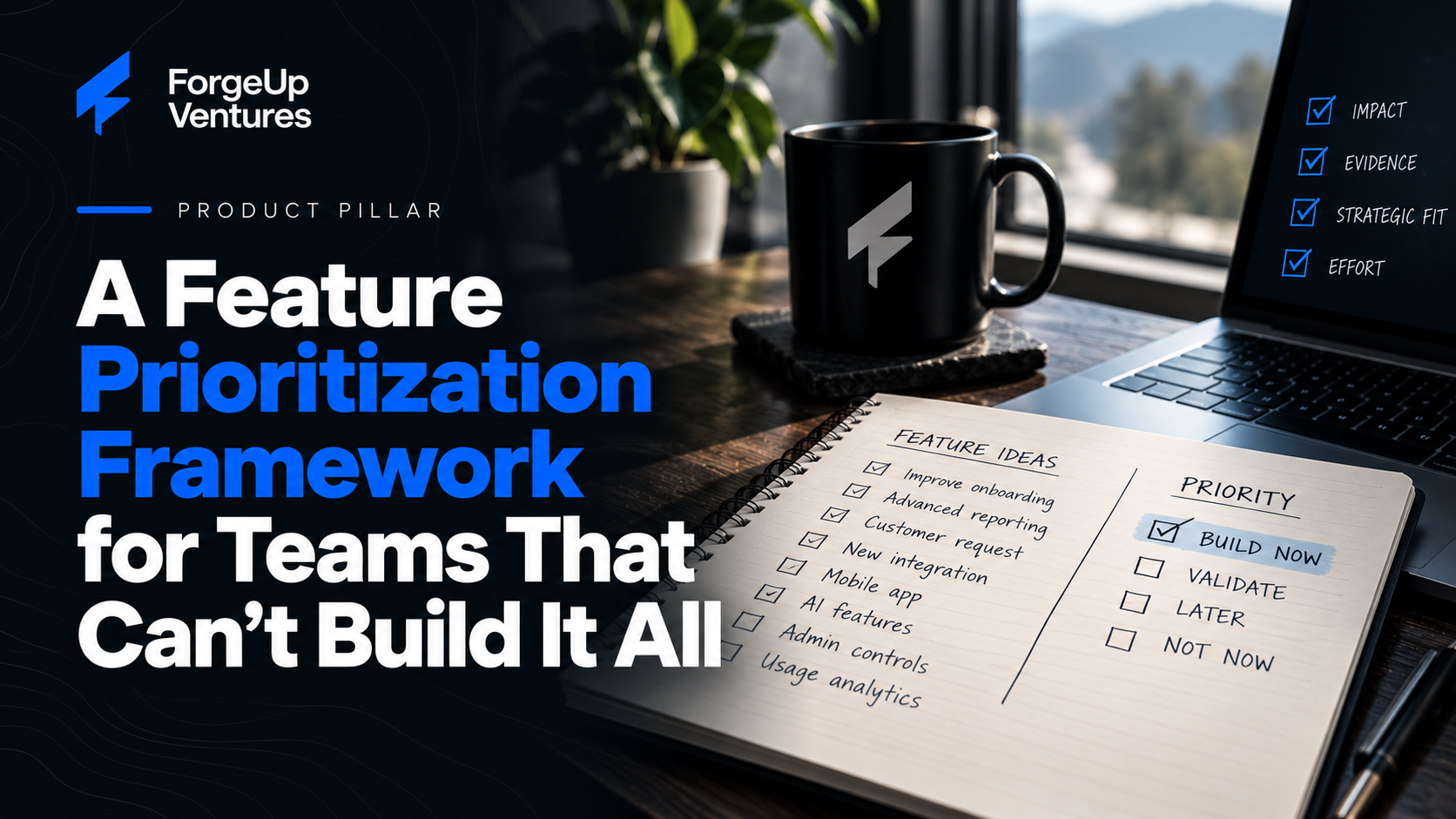
Helping founders prioritize what matters, connect product decisions to customer and business needs, and avoid building features that don't support growth.
IP and Corporate Legal
Identifying legal, structural, and defensibility considerations that become increasingly important as companies scale and prepare for future financing.
Operations
Creating clearer accountability, stronger internal processes, and the operational structure needed to support a growing business.
The goal isn't to overwhelm founders with more information.
It's to help them address the work that's keeping their companies from moving forward.
That's why we describe ForgeUp as an execution-focused growth program—not a traditional accelerator.
What About Hiring Fractional Executives?
For some startups, fractional leadership is another strong option.
A fractional CRO, CMO, COO, or Chief of Staff can provide experienced leadership without the cost of a full-time executive.
But hiring one fractional leader doesn't necessarily solve cross-functional problems.
A sales issue might actually originate in positioning.
A marketing problem might stem from product-market misalignment.
An operational bottleneck might prevent the sales team from executing consistently.
These challenges rarely exist in isolation.
Founders should consider whether they need expertise in one specific function or coordinated support across several functions.
That distinction can determine whether a fractional hire or a broader growth program delivers more value.
Five Questions to Ask Before Choosing Your Next Program
Before committing time, capital, or equity to another startup program, ask:
1. Are we still validating the business, or are we trying to scale something that's already working?
Your stage should determine the support you pursue.
2. Will this program help us execute, or primarily tell us what to do?
Both can be useful, but they're not interchangeable.
3. Does the program address our actual bottlenecks?
A strong investor network won't fix an ineffective sales process.
4. Who will be doing the work?
Understand whether you're receiving mentorship, strategic recommendations, operational support, or hands-on implementation.
5. What should be different when the program ends?
Look for tangible improvements in processes, capabilities, accountability, and growth infrastructure—not just more connections or completed workshops.
The Next Stage Requires a Different Playbook
Raising capital is an important milestone.
But it isn't the finish line.
It's the beginning of a new set of expectations.
Your investors want to see progress. Your team needs direction. Your customers expect consistency.
And you need a business that can grow without every decision, sale, and operational process depending entirely on you.
The right support at this stage should help you build that business.
Not simply prepare another pitch deck.
Not add another collection of advice you'll struggle to implement.
And not convince you that every growth problem requires another expensive hire.
The question isn't whether your startup needs another program.
It's whether your company has the execution infrastructure required for what comes next.
If you've already raised capital, established early traction, and are working to turn that traction into repeatable growth, ForgeUp was built for this stage.
We work alongside founders to identify growth constraints, strengthen execution, and build the systems that support the next phase of the company.
You've raised. You've built. Now it's time to make growth repeatable.
Learn More About the ForgeUp Program →
Keep on reading


Ready to ForgeUp?
Apply now and let's build the growth engine your company deserves.