Product-Led Growth vs Sales-Led Growth: Which Fits Your Startup?
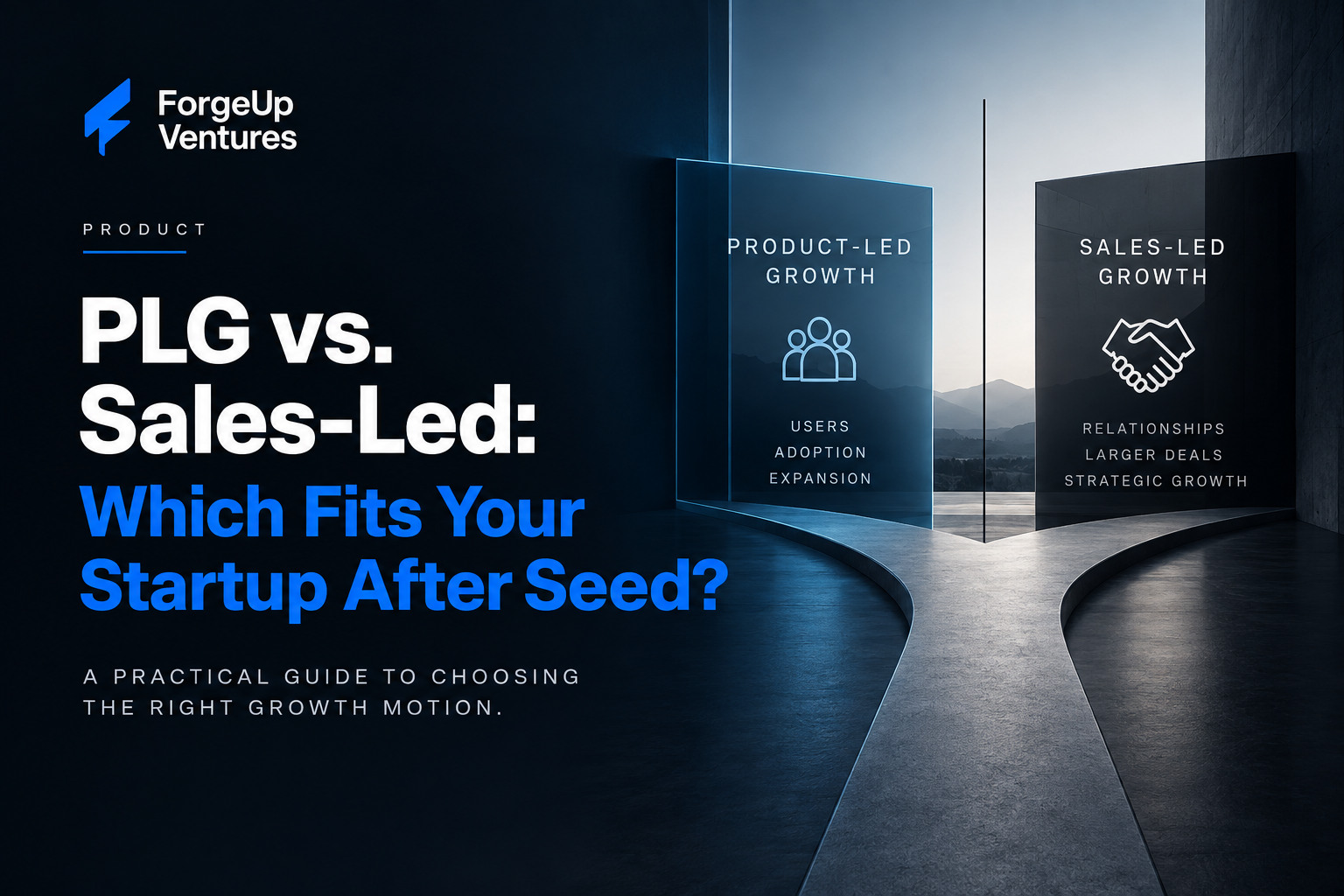
PLG vs. Sales-Led: Which Fits Your Startup After Seed?
After raising a seed round, founders face a familiar pressure: grow faster.
The question is how.
Should the product drive acquisition, activation, and expansion? Or should a sales team guide prospects through a higher-touch buying process?
In other words, should you pursue product-led growth or sales-led growth?
The debate around product-led growth vs sales-led growth is often framed as though one is the modern answer and the other is an outdated approach.
That is the wrong question.
Neither model is inherently better.
The right growth motion depends on how your customers discover value, how they buy, how complex your product is, and what it takes to convert someone into a successful customer.
For a post-seed startup, choosing incorrectly can become expensive quickly.
Before you start hiring salespeople or building a self-service funnel, you need to understand which motion your business can actually support.
What Is Product-Led Growth?
Product-led growth, or PLG, uses the product itself as a primary driver of customer acquisition, conversion, retention, and expansion.
Think free trials, freemium products, self-service onboarding, and users experiencing meaningful value before they ever speak with a salesperson.
The basic idea is simple:
Let people use the product before asking them to buy it.
When PLG works, it can create an efficient growth engine.
Users discover the product, sign up, reach value quickly, and eventually convert or expand based on their experience.
But there is an important distinction.
Offering a free trial does not make your company product-led.
A true PLG motion requires a product that can communicate its value with relatively little human intervention.
If users consistently need a 45-minute demo, custom implementation, extensive training, or executive buy-in before they understand the value, your product may not be suited for a pure PLG strategy.
What Is Sales-Led Growth?
Sales-led growth relies more heavily on people to move prospects through the buying journey.
Sales teams prospect, qualify opportunities, run discovery, demonstrate the product, navigate stakeholders, negotiate contracts, and help buyers reach a decision.
This approach makes sense when the purchase is more complex.
Enterprise software is an obvious example.
A $100,000 annual contract involving security reviews, procurement, legal, multiple departments, and executive approval is unlikely to convert through a "Start Free Trial" button.
The buyer needs guidance.
More importantly, the organization needs guidance.
Sales-led growth works particularly well when the product has a higher contract value, multiple stakeholders, longer implementation requirements, or a problem that needs to be diagnosed before the value becomes obvious.
The tradeoff is cost.
Salespeople are expensive. Sales cycles can be long. Pipeline needs to be actively created and managed.
That means a sales-led model needs economics that justify the additional human effort required to acquire each customer.
PLG vs. Sales-Led Growth: Start With How Your Customer Buys
Founders sometimes choose a growth motion based on what they want their company to look like.
PLG sounds efficient.
Enterprise sales sounds prestigious.
Neither matters if it conflicts with customer behavior.
Instead, start with the buyer.
Ask yourself:
Can a user experience meaningful value without talking to us?
If yes, that is a strong signal for PLG.
Does one individual have the authority to purchase?
If a user can swipe a credit card and get started, PLG becomes easier. If six stakeholders need to approve the purchase, sales probably needs to be involved.
How difficult is implementation?
A product that works immediately is very different from one requiring integrations, data migration, security reviews, or workflow changes.
How expensive is the product?
As contract value increases, buyers typically expect more interaction and organizations introduce more scrutiny.
Does the customer already understand the problem?
Self-service works better when users recognize their pain and understand the type of solution they need. If you first have to educate the buyer on the problem, human interaction may be essential.
Your customers' buying behavior should shape the motion, not the other way around.
The Case for Product-Led Growth
PLG can be powerful when the product naturally lends itself to discovery and adoption.
It is particularly attractive when you have a large addressable user base, relatively low friction to get started, quick time-to-value, and the ability for usage to expand organically.
A strong PLG company might see one employee begin using the product, invite several teammates, and eventually create enough adoption that the company upgrades.
The product creates the momentum.
For post-seed startups, that can produce several advantages.
Customer acquisition can become more efficient. Users generate behavioral data before a sales conversation happens. Product teams see exactly where adoption succeeds or fails. Expansion can happen naturally as usage increases.
But PLG introduces its own challenges.
If users sign up but never reach value, you have not built a growth engine. You have built a signup engine.
Activation matters more than registration.
Retention matters more than downloads.
Revenue matters more than traffic.
A PLG strategy only works when product usage reliably leads toward commercial value.
The Case for Sales-Led Growth
Sales-led growth becomes especially valuable when your solution requires context.
Maybe your product solves an expensive operational problem.
Maybe each customer has different workflows.
Maybe the person using the product is not the person approving the budget.
Maybe your solution changes how an entire department operates.
In these cases, sales is not simply a distribution channel.
Sales is part of the customer experience.
Good discovery helps the customer understand the cost of their problem.
A strong demo connects the product to their specific environment.
A salesperson identifies stakeholders, builds internal consensus, and helps the buyer navigate a complicated decision.
For early-stage companies, founder-led sales also provides something incredibly valuable: direct market intelligence.
Founders hear objections firsthand.
They learn which problems create urgency.
They see which features actually matter.
They understand why customers buy and why they walk away.
That information can shape product, positioning, pricing, and eventually the sales process itself.
You May Not Need to Choose Just One
The most useful answer to the PLG vs. sales-led debate is sometimes:
Both.
A hybrid motion can use the product to create demand and qualify users, then introduce sales when the opportunity becomes large or complex enough to justify it.
A user might begin with a free trial.
Usage grows.
Several coworkers join.
The account demonstrates clear intent.
Then sales enters the conversation to discuss an enterprise deployment.
In this model, product usage creates the signal and sales helps capture the larger opportunity.
The reverse can also happen.
Sales may land the initial enterprise customer, while the product is designed to make adoption and expansion increasingly self-service after the contract is signed.
The important thing is not whether your company fits neatly into a PLG or sales-led label.
It is whether the pieces work together.
A Simple Decision Framework for Post-Seed Founders
If you are deciding which growth motion deserves investment after seed, evaluate your company across five dimensions.
1. Time-to-Value
Can a new user experience the core value quickly and independently?
The shorter the path, the stronger the case for PLG.
2. Buying Complexity
How many people participate in the purchase?
More stakeholders generally increase the need for sales.
3. Contract Value
Can your customer acquisition model economically support human involvement?
Higher ACV can justify a more expensive sales motion.
4. Product Complexity
Does successful adoption require customization, integrations, training, or implementation?
Complexity often favors sales-assisted growth.
5. Expansion Potential
Can individual users naturally bring the product deeper into an organization?
If adoption creates more adoption, PLG may become a powerful part of the strategy.
None of these factors should be evaluated in isolation.
Together, they reveal how your customers actually want to buy.
Do Not Scale a Motion You Have Not Proven
This is the part that matters most after seed.
Once capital is in the bank, there is pressure to build the machine quickly.
Hire the sales team.
Invest in demand generation.
Build the free tier.
Add onboarding automation.
Increase acquisition.
But scaling an unproven growth motion does not create predictability.
It creates more volume around something you do not fully understand yet.
Before making a major investment in PLG, prove that users can consistently reach value without intervention.
Before building a sales organization, prove that the founder can repeatedly sell to a defined customer through a process someone else can eventually learn.
Before building a hybrid model, understand exactly when product should hand an opportunity to sales and why.
The goal after seed is not to choose the growth strategy that sounds most scalable.
It is to identify the motion your customers are already telling you can scale.
Follow the Evidence
Product-led growth and sales-led growth are not competing philosophies.
They are tools.
Your job as a founder is to determine which tool fits the way your market actually works.
Look at your customers.
Look at how they discovered you.
Look at what happened before they bought.
Look at who participated in the decision.
Look at how long it took them to experience value.
Look at what caused them to expand.
The answers are probably already giving you clues.
Because the best growth motion is not the one investors are talking about, the one your competitors use, or the one that looks best in your deck.
It is the one that makes it easiest for the right customers to discover, understand, buy, and expand with your product.
Build that first.
Then scale it.
Keep on reading
Ready to ForgeUp?
Apply now and let's build the growth engine your company deserves.