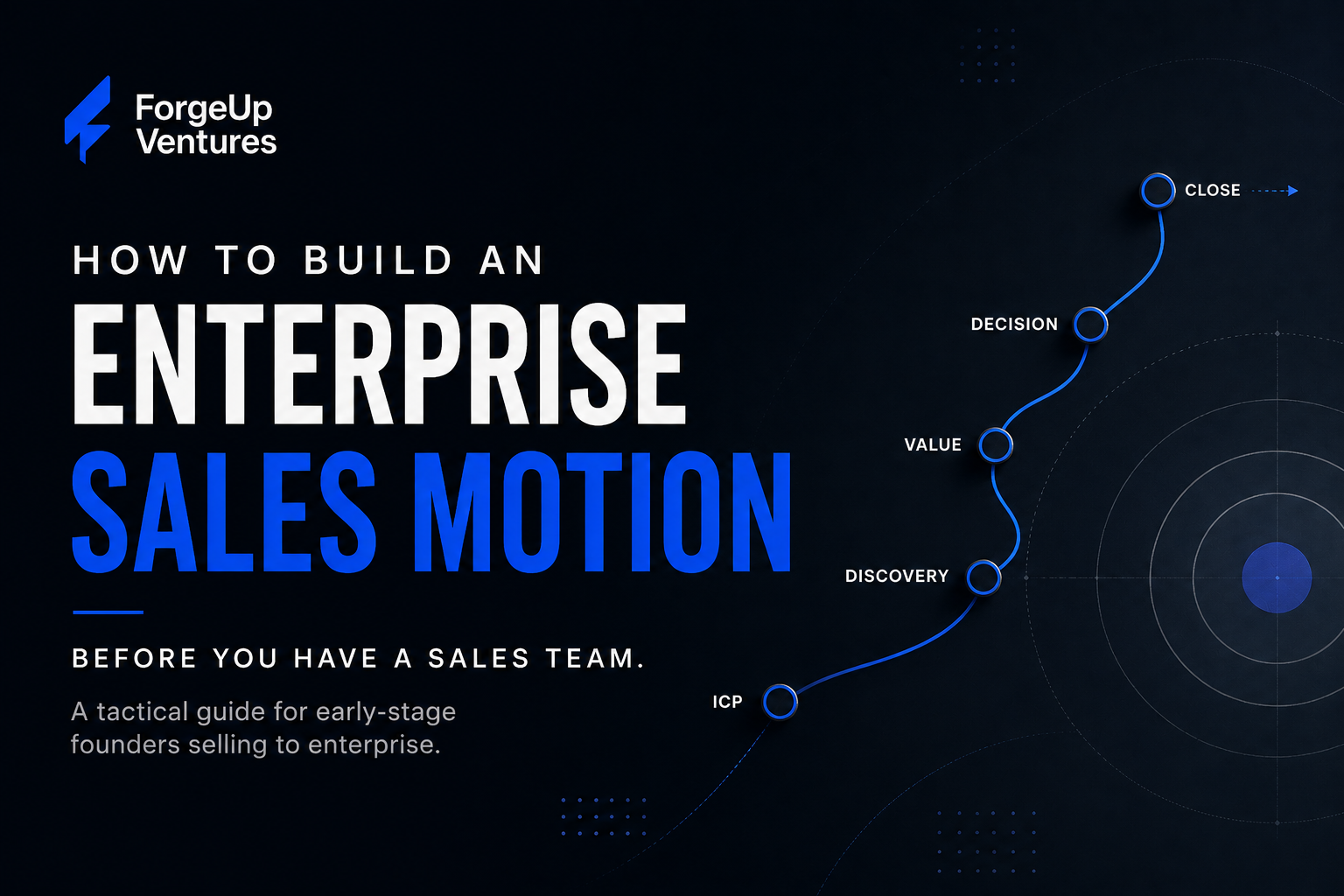
How to Build an Enterprise Sales Motion Before You Have a Sales Team
How to Build an Enterprise Sales Motion Before You Have a Sales Team
If you're an early-stage founder selling into enterprise, there's a good chance you're also your company's first salesperson.
That's not a temporary inconvenience.
It's one of the most important jobs you have.
Too many startups treat founder-led sales as something to survive until they can afford a VP of Sales or a few account executives. The assumption is that once the sales team arrives, they'll build the process.
That's backwards.
Your first sales hires should inherit a motion, not be responsible for discovering one from scratch.
Before you build a sales team, you need to understand who buys, why they buy, how they buy, what creates urgency, and what consistently moves a deal forward.
That's the foundation of an enterprise sales motion for early-stage startups.
Here's how to build it.
1. Start With a Narrow ICP
Enterprise sales gets significantly harder when your ideal customer profile is vague.
"Mid-market and enterprise companies" isn't an ICP.
Neither is "companies with more than 500 employees."
Your ICP should describe the organizations most likely to have the problem you solve, recognize its urgency, and have the ability and willingness to pay for a solution.
Start with your existing wins.
Look for patterns across:
- Industry or vertical
- Company size
- Buyer role
- Trigger events
- Current alternatives
- Pain severity
- Sales-cycle length
- Contract value
- Product adoption
The goal isn't to identify every company that could buy.
It's to identify the companies you have the strongest reason to believe will buy.
Early-stage startups rarely have enough resources to sell effectively to everyone. A narrow ICP makes almost everything downstream easier: prospecting, messaging, discovery, demos, product decisions, and eventually hiring.
2. Map the Buying Committee
Enterprise deals aren't usually won with one person.
The person who takes your first meeting may not control the budget. The person who loves your product may not have authority to approve it. And the executive who signs the contract may never attend a demo.
You need to understand the buying committee.
For each deal, identify:
The Champion: Who wants this to happen internally?
The Economic Buyer: Who controls or approves the budget?
The User: Who actually experiences the problem?
The Blockers: Who can slow or stop the purchase?
Depending on your product, that last group might include IT, security, procurement, finance, or legal.
Founder-led sales gives you an enormous advantage here because you're close enough to every deal to observe these dynamics firsthand.
Don't just track whether you won.
Track how the organization made the decision.
3. Build Discovery Around Problems, Not Features
Founders know their products extremely well.
That can make them terrible at discovery.
A prospect mentions a problem, and the founder immediately starts explaining how the product solves it.
Resist that instinct.
Your job during discovery isn't to prove that your product is impressive. It's to understand whether the problem is painful enough to justify change.
Ask questions such as:
What happens today?
Why is that a problem?
What does that problem cost the company?
Why solve it now?
What happens if nothing changes?
Who else cares about solving this?
The answers give you more than sales information. They give you positioning, product, pricing, and marketing intelligence.
If you're hearing dramatically different answers across every conversation, that may also be a signal that your ICP is still too broad.
4. Document What Happens When You Win
Early sales often feels chaotic because every deal looks different.
Look underneath the surface.
Patterns usually exist.
Take your last few wins and reconstruct them from first interaction to signature.
Where did the opportunity originate?
What made the prospect respond?
What happened during discovery?
When did urgency become apparent?
Who became the champion?
Which objection almost stopped the deal?
What proof created confidence?
What caused the prospect to finally say yes?
Now do the same thing with lost deals.
The difference between the two is where your sales process begins.
You're not trying to create a 50-page sales manual.
You're trying to identify the repeatable behaviors that increase the probability of winning.
5. Define Your Sales Stages Around Buyer Actions
A CRM full of stages doesn't mean you have a sales process.
Especially if those stages are:
Meeting Scheduled → Demo → Proposal → Negotiation → Closed
Those describe what you did.
A stronger enterprise sales motion tracks what the buyer has done.
For example:
Problem Confirmed — The buyer acknowledges a meaningful problem.
Qualified Opportunity — The problem, buyer, urgency, and potential value fit your criteria.
Internal Champion Identified — Someone inside the organization is actively helping move the deal forward.
Decision Process Confirmed — You understand who approves the purchase and what must happen.
Commercial Alignment — Scope, pricing, and expected outcomes are aligned.
Procurement/Legal — The organization has entered its formal approval process.
Now pipeline becomes more than a list of optimistic opportunities.
It becomes evidence of actual buying progress.
6. Create a Lightweight Sales Operating System
You don't need enterprise-level sales operations when you're a five-person startup.
You do need consistency.
At minimum, every legitimate opportunity should capture:
- Account and primary contacts
- Problem being solved
- Business impact
- Champion
- Economic buyer
- Decision criteria
- Decision process
- Next step
- Expected close date
- Reason won or lost
Then create a weekly rhythm.
Review active opportunities.
Identify stalled deals.
Look at what entered pipeline.
Review what moved forward.
Discuss what was lost and why.
Founder-led sales becomes much more valuable when learning compounds across deals instead of disappearing after each call.
7. Don't Hire Sales Until You Can Teach Sales
This is where many startups get into trouble.
The founder closes several customers and decides it's time to scale.
They hire an experienced salesperson.
Three months later, the salesperson hasn't closed much.
Six months later, everyone is frustrated.
The founder concludes they made a bad hire.
Sometimes they did.
Sometimes the company handed someone a product, a CRM login, and a revenue target and called it a sales strategy.
Before hiring someone to replicate your sales motion, you should be able to explain:
Who should they target?
Why does that customer buy?
Who should they contact?
What should they say?
How do they qualify an opportunity?
What does a successful discovery call uncover?
What are the common objections?
What does the buying process usually look like?
Why do you win?
Why do you lose?
You don't need perfect answers.
You need enough evidence that the new hire is executing and improving a motion, not inventing one.
Founder-Led Doesn't Mean Founder-Dependent
The goal of founder-led sales isn't to keep the founder selling forever.
It's to use the founder's proximity to the market to discover what works before attempting to scale it.
Every conversation should make the motion clearer.
Every win should reveal a pattern.
Every loss should teach you something.
Over time, instinct becomes documentation.
Documentation becomes process.
Process becomes repeatability.
Repeatability is what allows you to add people without simply adding cost.
That's the difference between founder-led sales and founder-dependent sales.
One is a stage.
The other is a bottleneck.
Build the Motion Before You Build the Team
Your first sales hire shouldn't walk into a finished machine.
Early-stage companies are too dynamic for that.
They also shouldn't walk into a blank page.
Before you build the team, build enough of the motion to answer the fundamental questions:
Who are we selling to?
What problem are they buying us to solve?
How does an enterprise customer actually make the decision?
What consistently moves a deal forward?
Why do we win?
Then your first sales hires can do what you actually need them to do:
Take something that works, make it better, and make it repeatable.
Hiring salespeople isn't what creates an enterprise sales motion.
Understanding how your customers buy does.
That work starts long before you have a sales team.
Keep on reading


Ready to ForgeUp?
Apply now and let's build the growth engine your company deserves.