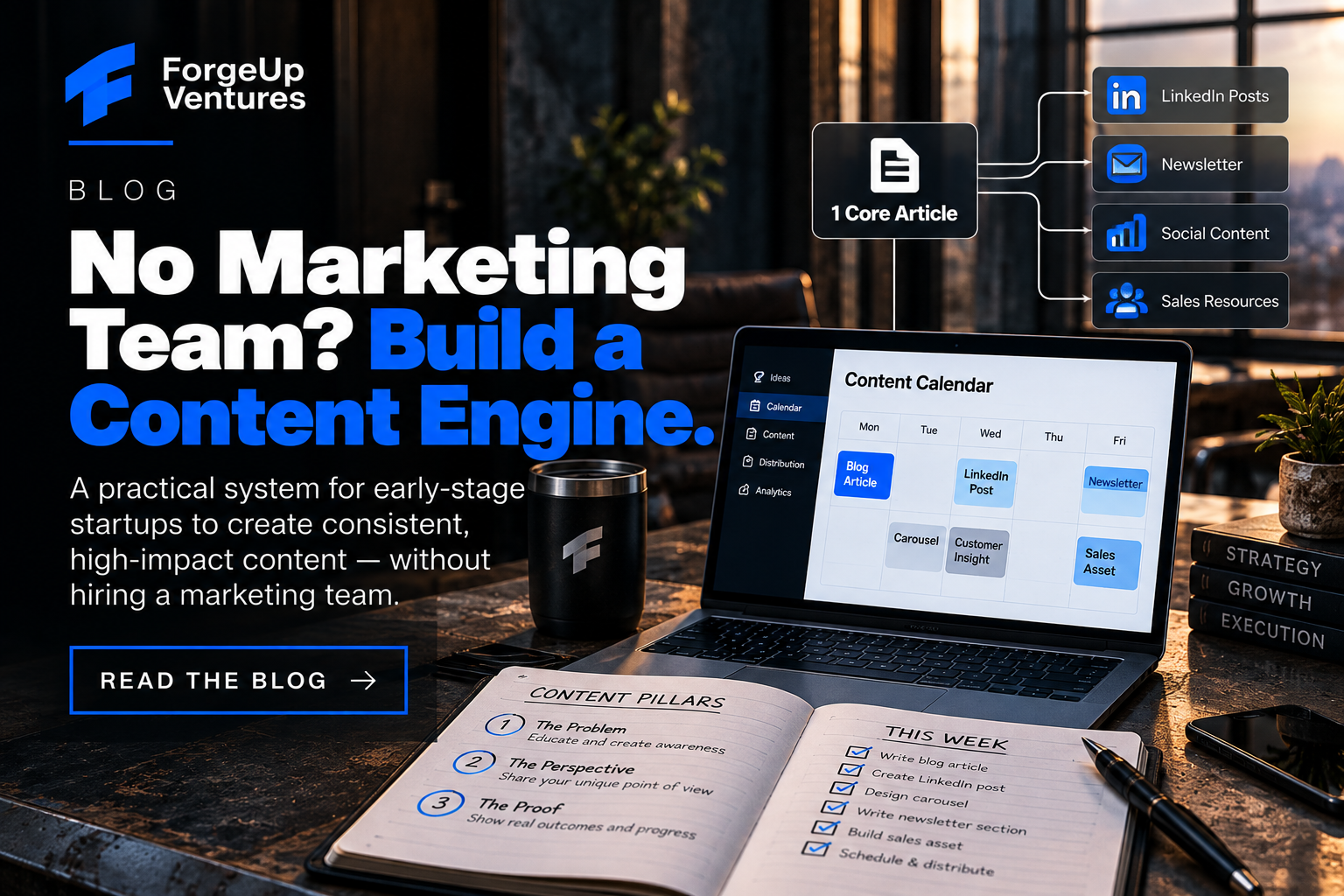
How early-stage B2B founders can build a repeatable content system without hiring a marketing department or spending hours creating posts.
You've raised your seed round. You're building your product, talking to customers, managing your team, and trying to generate predictable revenue.
Somewhere in the middle of all that, someone says:
"We need to start posting more content."
They're probably right.
But there's a problem. You don't have a marketing team. You don't have a content strategist, copywriter, designer, or social media manager. And you certainly don't have 15 hours a week to spend creating LinkedIn posts.
So marketing becomes another item on an already overwhelming to-do list.
The solution isn't producing more content.
It's building a content engine that turns the work you're already doing into consistent, valuable marketing.
Here's how to build one.
1. Stop Thinking About Content as a Separate Job
One of the biggest mistakes early-stage founders make is treating content creation as something that happens outside the business.
They sit down, open a blank document, and ask themselves:
"What should we post about this week?"
That's the wrong starting point.
Your best content already exists inside your company.
It's hiding in sales conversations, customer onboarding calls, product decisions, investor questions, and the objections your team hears repeatedly.
These conversations reveal what your market actually cares about.
Instead of brainstorming random topics, start capturing what you're already learning.
Create a simple document with four categories:
- Customer questions: What are prospects consistently asking?
- Sales objections: What prevents buyers from moving forward?
- Product insights: What have you learned about solving your customers' problems?
- Industry perspectives: What does your team believe that others in your market overlook?
Every meaningful conversation becomes potential content.
You don't need more ideas.
You need a system for capturing the ones you already have.
2. Build Around Three Content Pillars
Without clear direction, startup content quickly becomes inconsistent.
One week you're posting product announcements. The next you're sharing motivational quotes. Then you disappear for three weeks because everyone gets busy.
A content engine needs structure.
Start with three pillars that connect directly to your business.
Pillar 1: The Problem
Educate your market about the challenges your product solves.
Discuss common mistakes, operational inefficiencies, outdated processes, and the hidden costs of doing nothing.
Pillar 2: The Perspective
Share your company's unique point of view.
What have you learned from working with customers? What industry assumptions do you disagree with? What approaches do you believe work better?
Pillar 3: The Proof
Demonstrate that your solution creates meaningful outcomes.
Share customer stories, product walkthroughs, implementation lessons, early results, and examples of how your team solves real problems.
If you don't have customer case studies yet, use credible examples and clearly distinguish expected outcomes from demonstrated results.
Together, these pillars establish relevance, authority, and credibility.
They also make content planning significantly easier.
3. Create One Core Piece of Content Each Week
Here's where most founders overcomplicate the process.
They assume consistent marketing requires creating something new every day.
It doesn't.
One strong piece of content can become an entire week's worth of marketing assets.
Start with a single core topic.
For example:
"Why Enterprise Sales Breaks After a Startup Raises Its Seed Round."
Turn that topic into one substantial article, founder interview, or recorded conversation.
Then repurpose it into:
- A LinkedIn post highlighting the main argument.
- A second post explaining a practical takeaway.
- A short carousel outlining the framework.
- A newsletter section sharing the insight.
- A sales follow-up resource for relevant prospects.
That's five potential marketing assets from one idea.
Not five separate brainstorming sessions.
The key is adapting the message to each format rather than copying the same paragraph everywhere.
This is how small teams create consistent visibility without multiplying their workload.
4. Establish a Simple Weekly Production Workflow
A content engine only works if it fits into your actual operating schedule.
For most early-stage B2B startups, a lightweight weekly process is enough to begin.
Here's an example:
DayActivityTimeMondayCapture insights and choose a topic20 minutesTuesdayDraft one core content piece60 minutesWednesdayRepurpose into 2–3 smaller assets45 minutesThursdayReview, schedule, and distribute30 minutesFridayCheck performance and record insights15 minutes
Total: Approximately 2 hours and 50 minutes per week.
These are planning estimates, not guaranteed production times. Your workflow may take longer initially.
The important part is assigning ownership.
One person should be accountable for moving content from idea to publication.
That might be the founder, an operations lead, or a part-time contractor.
Without ownership, content becomes everyone's responsibility and nobody's priority.
5. Use AI to Accelerate Production, Not Replace Your Expertise
AI can make a lean content operation dramatically more efficient.
But there's a difference between using AI to organize your thinking and asking it to manufacture your company's point of view.
Generic AI-generated content rarely differentiates a startup.
Your advantage comes from the knowledge your team has earned through real customer interactions.
Use AI to:
- Turn recorded founder conversations into structured drafts.
- Extract themes from customer questions.
- Repurpose articles into social content.
- Generate headline variations.
- Create initial outlines and editorial calendars.
Then have someone with firsthand knowledge review the material.
Remove generic claims. Verify statistics. Add specific examples. Make sure the content reflects what your company actually believes.
AI should reduce production friction, not eliminate the expertise that makes your content valuable.
6. Connect Content to Your Sales Motion
Publishing consistently is useful.
Publishing content that supports revenue generation is significantly more valuable.
Every piece of content should serve a purpose within your buyer's journey.
For example:
Awareness: Help prospects recognize a problem they may be underestimating.
Consideration: Explain how to evaluate potential solutions.
Decision: Address objections, implementation concerns, and purchasing questions.
Your sales team, or the founder handling sales, should be able to use these assets in real conversations.
A well-written article answering a common objection can become a valuable follow-up after a discovery call.
A product walkthrough can help internal champions explain your solution to other stakeholders.
A practical framework can give prospects a reason to reengage.
When content supports the sales process, it becomes more than a visibility exercise.
It becomes part of your go-to-market infrastructure.
7. Measure What Matters Before Scaling Output
Early-stage founders often evaluate content using likes, impressions, and follower counts.
Those metrics provide useful context, but they don't tell the entire story.
Start with a small set of indicators tied to your goals:
- Are target buyers engaging with your content?
- Are prospects mentioning articles during sales conversations?
- Is content generating relevant website visits?
- Are published resources helping move opportunities forward?
- Which topics produce meaningful conversations?
Review these signals monthly.
Look for patterns before increasing publishing frequency.
If one topic consistently attracts your ideal customers, develop more content around it.
If another generates impressions but no meaningful engagement, reconsider its role.
The goal isn't to become a media company. It's to build a repeatable system that helps your startup grow.
The Bottom Line: Consistency Comes From Systems
You don't need a full marketing department to build a credible presence in your market.
You need a process for capturing insights, organizing ideas, creating useful content, distributing it consistently, and learning from the results.
Start with three content pillars.
Create one strong piece of content each week.
Repurpose it intelligently.
Connect it to your sales motion.
Measure what actually matters.
Then improve the system as your company grows.
The startups that win at content aren't necessarily the ones publishing the most. They're the ones building a process they can sustain.
Build Marketing That Supports Real Growth
At ForgeUp Ventures, we work alongside early-stage founders to turn scattered marketing activities into repeatable growth systems.
From positioning and messaging to go-to-market execution and operational infrastructure, our focus is on helping founders build the processes that support their next stage of growth.
Because growing a company requires more than good ideas.
It requires consistent execution.
Learn more about how ForgeUp Ventures helps founders build predictable growth.
Explore ForgeUp Ventures: https://forgeup.vc
Keep on reading



Ready to ForgeUp?
Apply now and let's build the growth engine your company deserves.