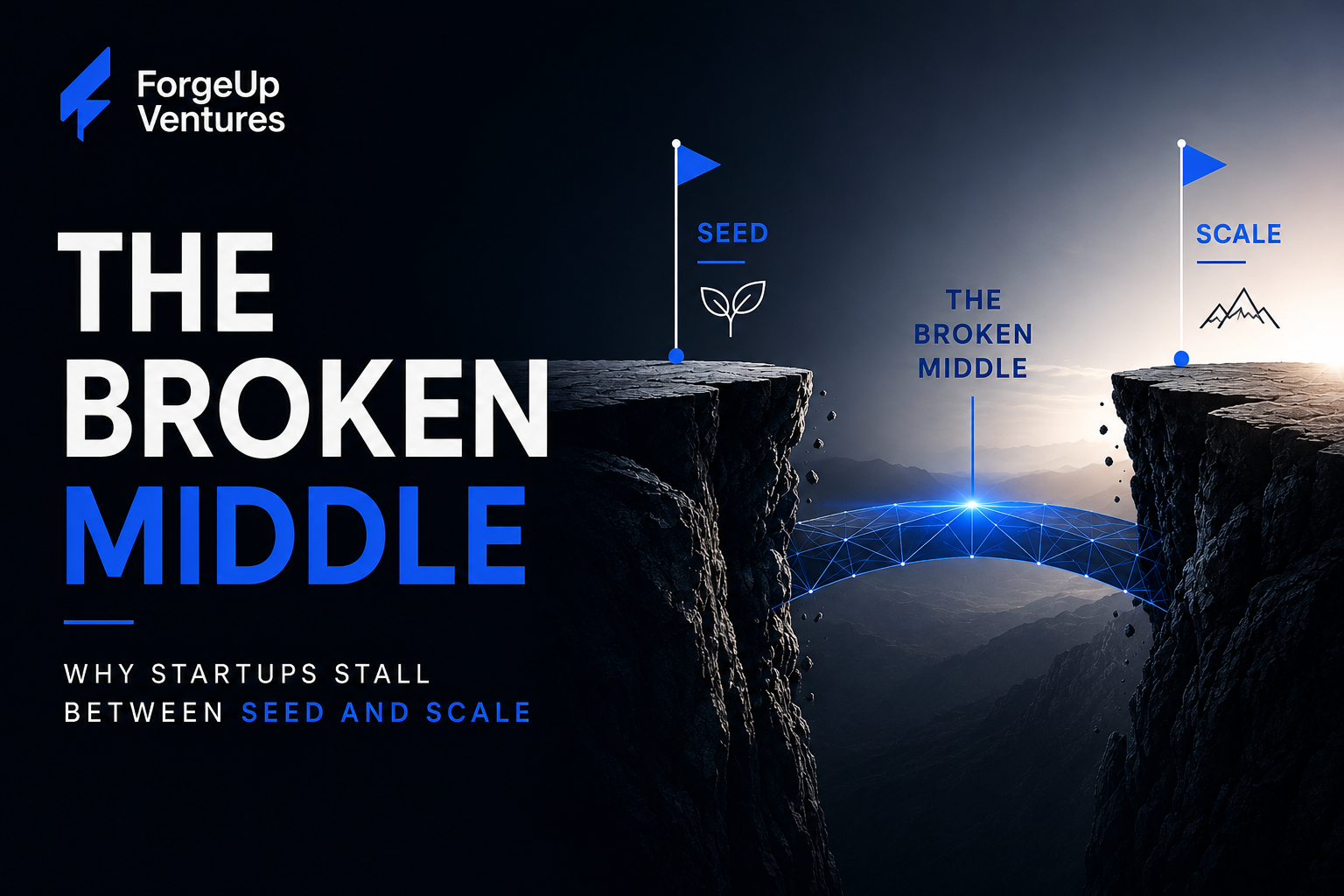
The Broken Middle: Why Startups Stall Between Seed and Scale
You raised your seed round.
Now what?
For many founders, figuring out what to do after raising a seed round is surprisingly harder than getting to the round itself.
Before the raise, the objective was relatively clear: build something customers want, demonstrate traction, convince investors there is a meaningful opportunity, and secure enough capital to keep building.
After the money hits the bank, expectations change.
Now you're supposed to hire. Grow revenue. Build the product. Create pipeline. Develop a go-to-market strategy. Establish processes. Hit milestones. Prepare for the next round.
Preferably all at once.
This is where many promising startups enter what we call the Broken Middle: the uncomfortable stretch between proving that something can work and proving that it can work repeatedly, predictably, and at scale.
The company isn't starting from zero anymore. There are customers to support, employees to manage, investors to update, a product roadmap to maintain, and revenue targets to hit.
But it isn't a scalable business yet, either.
Sales may still depend heavily on the founder. Customer acquisition is inconsistent. Messaging changes depending on who is pitching. The product may serve several different use cases. The team is busy, but it isn't always clear which activities are actually creating growth.
The startup has traction.
What it doesn't have yet is a machine.
This is where promising startups stall.
The Seed Round Isn't the Finish Line
One of the most dangerous things about raising a seed round is that it can create the illusion that the hardest question has already been answered.
It hasn't.
Seed funding gives a startup more resources to answer the question that matters next:
Can we turn early traction into a repeatable business?
Before seed, progress can be messy.
A founder can personally close the first ten customers. The team can customize onboarding for every account. Product decisions can happen in Slack. Pricing can change from deal to deal. Everyone can operate through instinct, urgency, and sheer effort.
At a small enough scale, that works.
Then the company raises capital and tries to grow.
Suddenly, those informal systems begin to break.
The founder can't personally manage every deal. The product team can't build every feature customers request. Marketing can't generate qualified demand if nobody can clearly define the ideal customer. And salespeople can't reproduce a sales process that only exists inside the founder's head.
The very things that helped the company reach seed can become the things preventing it from reaching scale.
Welcome to the Broken Middle
The Broken Middle startup isn't defined by a particular revenue number or funding stage. It's defined by a transition.
The startup has moved beyond discovery, but it hasn't reached repeatability.
It has enough evidence to know there is something worth pursuing, but not enough operational consistency to scale it confidently.
This often shows up in predictable ways.
Revenue exists, but it isn't predictable. One month is great; the next is quiet. A large customer closes, but the team isn't sure how to find ten more like them.
The founder is still the sales engine. Customers buy because the founder knows how to tell the story, navigate objections, adjust the pitch, and create momentum when a deal stalls.
Then the company hires its first salesperson and expects that person to replicate the result.
They can't.
Not necessarily because they're a bad salesperson, but because the company hasn't actually built a sales system yet.
It has built founder intuition.
Those are very different things.
The ideal customer profile may also remain too broad. Early startups are rewarded for saying yes, to new use cases, new industries, new features, and new types of customers.
Eventually, all those yeses create a company trying to serve several markets at once.
Messaging gets weaker. The roadmap gets noisier. Sales cycles become inconsistent. Marketing struggles because there is no clearly defined audience to reach.
Meanwhile, everyone is busy.
They're shipping features, creating content, taking sales calls, attending conferences, building partnerships, launching campaigns, updating investors, and putting out fires.
There is activity everywhere.
Activity and traction are not the same thing.
You Can't Hire Your Way Out of the Broken Middle
Once capital is available, hiring feels like progress.
Need more sales? Hire salespeople.
Need more leads? Hire marketing.
Need more product velocity? Hire engineers.
Sometimes those hires are exactly what the company needs.
Adding people to a system that isn't working doesn't automatically fix the system.
It can make the problem more expensive.
If your ICP isn't clear, a bigger marketing budget spreads an unclear message to more people.
If your sales process isn't repeatable, hiring five salespeople gives you five people struggling with the same undefined process.
If customer feedback isn't translating into clear product priorities, adding engineers may simply help you build the wrong things faster.
Scale is a multiplier.
It multiplies what is already working and what isn't.
The job immediately after seed isn't simply to grow.
The job is to identify what deserves to be scaled.
What to Do After Raising a Seed Round
There will be pressure to move faster after closing a seed round.
Resist the temptation to interpret "faster" as "do more."
The objective should be to create repeatability.
That starts with five things.
1. Narrow Your Ideal Customer Profile
Look closely at your best customers, not simply your biggest ones.
Which customers experience the problem most acutely? Which understand the value proposition fastest? Which have shorter sales cycles? Which adopt successfully, renew, expand, or refer others?
Your early customer base is evidence. Use it.
The goal isn't to prove that many different types of companies could buy your product.
The goal is to determine which type of customer you can win again and again.
2. Turn Founder-Led Sales Into a Process
Founder-led sales is valuable because founders learn directly from the market.
Eventually, those lessons need to become institutional knowledge.
Document what happens when you win.
Where do your best opportunities originate? Who participates in the buying decision? What creates urgency? Which objections repeatedly appear? What proof points move deals forward? Why do customers choose you instead of doing nothing?
The goal isn't to remove the founder from sales overnight.
It's to convert what the founder knows intuitively into a process someone else can learn, test, and eventually reproduce.
3. Build a Real Customer Feedback Loop
Customer feedback shouldn't live in scattered call notes, Slack conversations, and someone's memory.
Create a deliberate system connecting:
Customer → Sales → Product → Customer Success → Leadership
Then look for patterns instead of reacting to individual requests.
One customer asking for a feature is feedback.
Ten customers describing the same underlying problem is a signal.
Your job is to know the difference.
4. Identify the Metrics That Prove Repeatability
Seed-stage companies can drown themselves in dashboards.
You don't need fifty KPIs.
You need the handful that tell you whether the business is becoming more predictable.
Depending on the company, those might include qualified pipeline, sales-cycle length, win rate, activation, retention, expansion, customer acquisition cost, or time-to-value.
Ultimately, you should be able to answer one question:
Are we getting better at acquiring and retaining the right customers?
If you can't answer that consistently, you're probably not ready to pour fuel on the fire.
5. Build Systems Before You Need Them
This doesn't mean introducing enterprise bureaucracy into a ten-person startup.
It means taking the things that work and making them repeatable.
How are leads qualified? How are deals managed? How does customer feedback reach product? How are priorities determined? How does a new salesperson learn the pitch? How does leadership know what's working?
A good system removes unnecessary dependence on individual people.
If the company stops functioning whenever the founder steps away, you don't have scale yet.
Post-Seed Founders Need a Different Kind of Support
The kind of help founders need in the Broken Middle is different from what they needed while validating an idea.
Early-stage programs often emphasize education, mentorship, networking, pitch preparation, fundraising, and introductions. Those resources can be valuable.
Once a startup has traction, founders often don't need another person explaining what they should do.
They need help doing it.
They need to determine why deals aren't converting. Narrow the ICP. Build the sales process. Pressure-test pricing. Identify the right metrics. Translate customer feedback into product decisions. And create accountability around execution.
Effective post-seed founder support needs to move beyond advice and toward implementation.
That's an important distinction when evaluating an accelerator vs. a growth program.
An accelerator may be exactly what a startup needs during an earlier phase of development. But a company already generating traction has a different challenge.
It isn't trying to accelerate an idea.
It's trying to turn evidence into a repeatable growth engine.
The question becomes less about "What can we learn?" and more about:
"What is preventing us from becoming repeatable, and what are we going to do about it?"
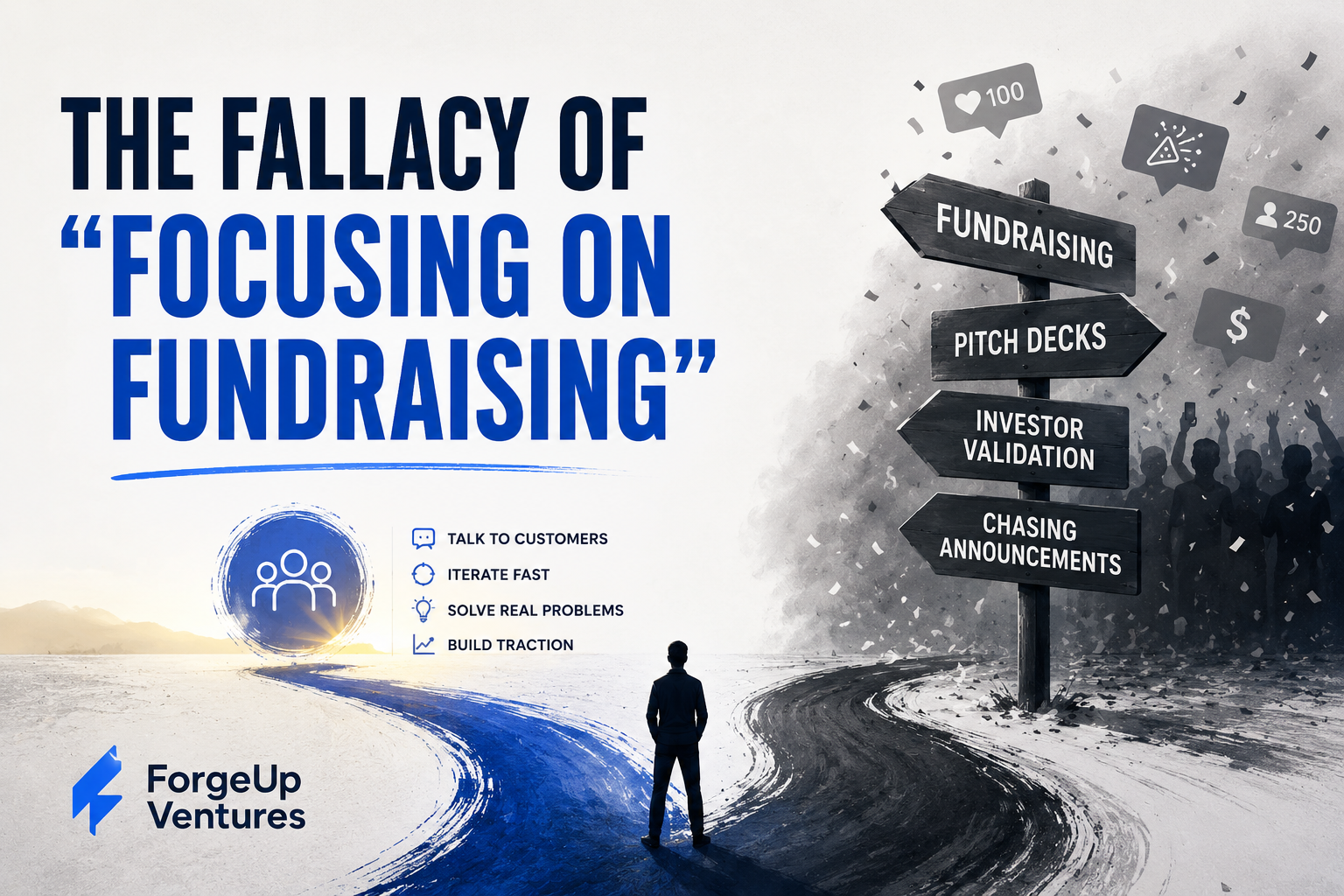
Don't Confuse Fundraising With Company Building
The next round will always be visible on the horizon.
That creates another trap: founders begin optimizing for the next fundraise instead of optimizing the business.
The deck gets updated. Investor conversations increase. The team starts thinking about what metrics will look impressive six months from now.
The strongest Series A story isn't created in a pitch deck.
It's created inside the business.
A clear ICP. Repeatable customer acquisition. Strong retention. Increasing sales efficiency. A product customers consistently value. A team that can execute without every decision routing through the founder.
Those aren't fundraising tactics.
They're evidence that the company is becoming scalable.
The Goal Isn't More. It's Repeatable.
The Broken Middle is difficult because there is rarely one dramatic problem to solve.
The product works.
Customers exist.
The company has money.
The team is growing.
From the outside, everything may look like momentum.
Inside, the founder can feel that the business is still being held together manually.
That feeling matters.
The answer isn't necessarily another hire, another campaign, another feature, or another funding round.
It's turning what worked once into something that works repeatedly.
From founder intuition to company process.
From scattered customers to a defined ICP.
From unpredictable wins to a repeatable revenue motion.
From activity to measurable execution.
From traction to infrastructure.
Seed capital gives you the resources to build that bridge.
Capital doesn't build it for you.
The startups that successfully move through the Broken Middle stop asking:
"How do we grow faster?"
Start asking:
"What have we proven works and how do we make it repeatable?"
That's the work between seed and scale.
It's where companies are actually built.
Keep on reading


Ready to ForgeUp?
Apply now and let's build the growth engine your company deserves.